Shanghai, China
+86-17317656853
inquiry@cgprotection.com


An arc flash suit is a piece of test equipment as much as it is a garment. The arc rating on the label describes the performance of a clean, undamaged, correctly assembled system — not of a fabric sample sitting in a laboratory. Oil contamination, a frayed cuff, a melted reflective stripe or a hood window scratched to opacity all reduce protection, usually without changing the number printed on the label.
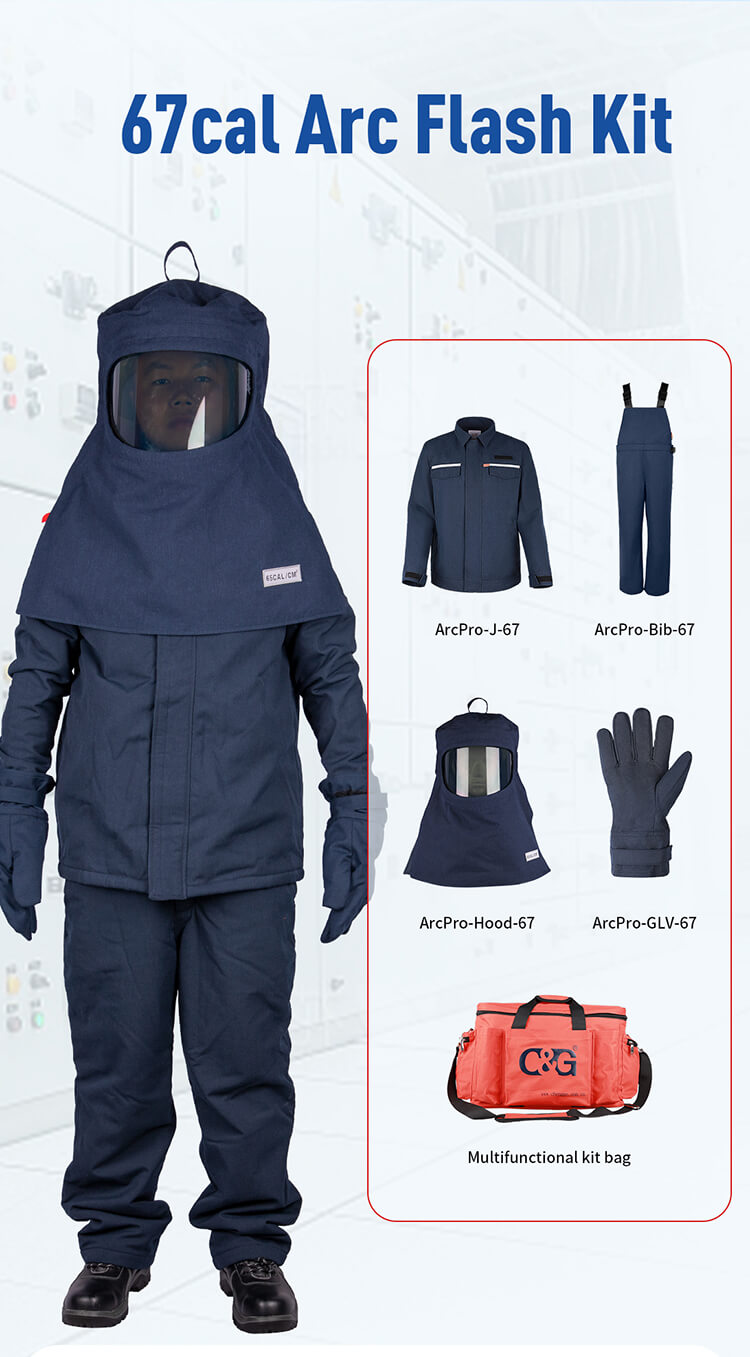
This guide sets out how to inspect, wash, repair, store and retire an arc flash suit so that the ATPV or EBT value still means what it says on the day of the job. It follows the care requirements of NFPA 70E together with the laundry, inspection and antistatic requirements that apply to the C&G ArcPro® range, which is tested to ASTM F1959, ASTM F1506-25, ASTM F2621, IEC 61482-1-1, EN ISO 11612:2015 and EN 1149-5:2018.
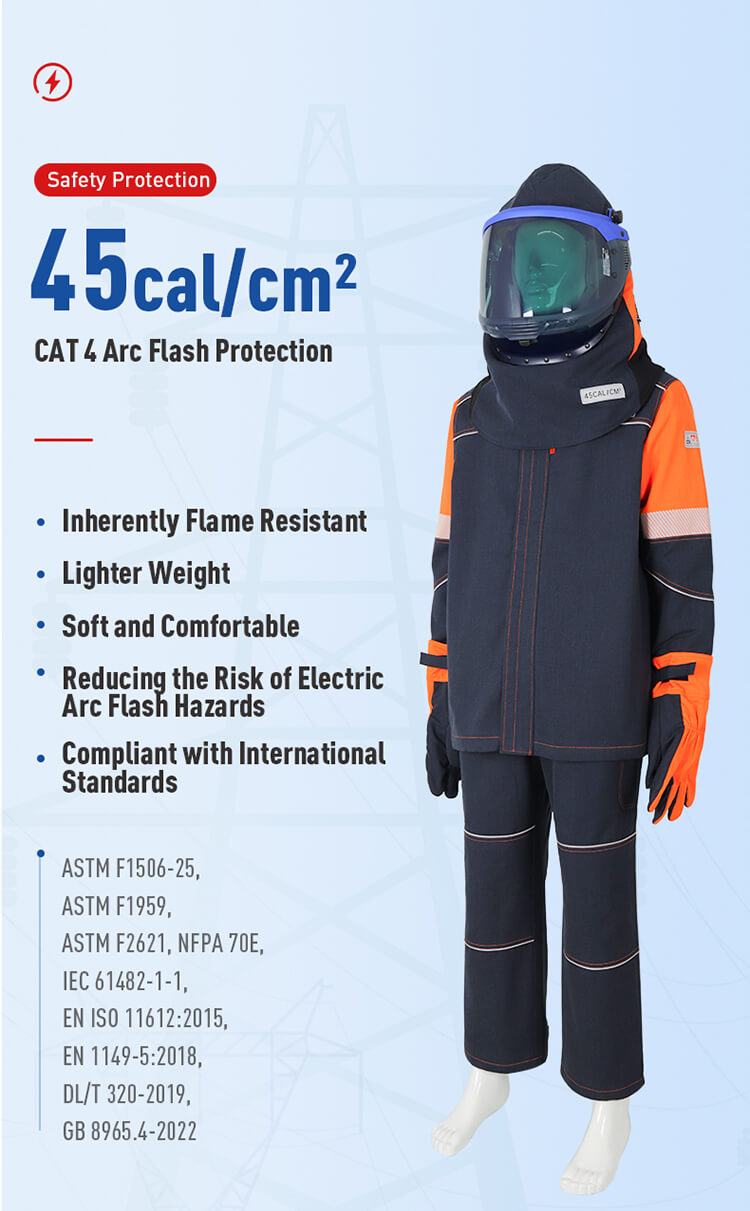
Arc-rated clothing protects in three ways: it does not melt, it insulates against the heat flux of the arc, and it keeps the products of combustion away from skin. Each of those mechanisms depends on the fabric being intact and free of anything that can burn. A 45 cal/cm² multi-layer suit with a palm-sized patch of hydrocarbon oil soaked into the sleeve is no longer a 45 cal/cm² suit at that spot.
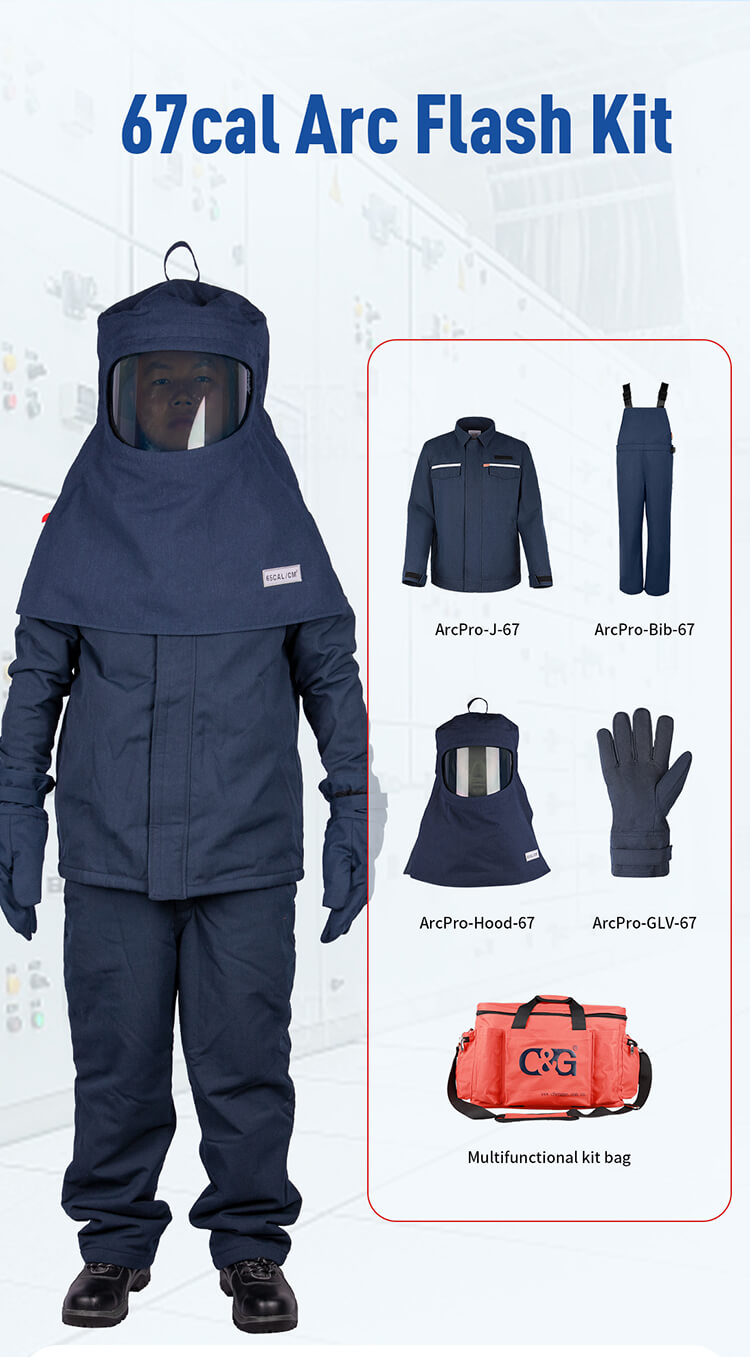
Assembly matters just as much as fabric. A hood that no longer seals at the collar, a jacket that has lost a closure, or gloves that are not the pair tested with the system all break the coverage that the rating assumes. That is why inspections look at the suit as a system rather than as a jacket and a pair of trousers.
Inspect in the same sequence every time so that nothing is skipped. Ten minutes at the start of a shift is cheaper than a replacement order after a near miss.
| Area | What to check | Action if it fails |
|---|---|---|
| Label and marking | Arc rating (ATPV/EBT), standard, size, care instructions and garment ID legible | Remove from service — an unmarked arc-rated garment cannot be verified |
| Outer fabric | Holes, tears, thin or shiny patches, charring, scorch marks, abrasion at cuffs, knees and seat | Repair with compatible arc-rated material or retire |
| Seams and stitching | Open seams, pulled or broken thread, loose bar-tacks at stress points | Repair with arc-rated thread only |
| Closures | Zippers that no longer close fully, missing teeth or sliders, worn hook-and-loop, missing studs | Repair or retire — a gap in closure is a gap in protection |
| Reflective trim | Lifting, cracking, discoloration, missing sections | Replace the trim; damaged trim can ignite |
| Hood and face protection | Cracks, crazing or opacity in the shield, loose window frame, damaged hood shell | Replace the shield or the hood; do not polish out damage |
| Gloves and leggings | Cuts, punctures, stiffened leather, perished coating | Retire the component, not only the pair |
| Contamination | Oil, grease, paint, solvent, hydraulic fluid, unknown stains, standing moisture | Clean to procedure, or retire if the substance cannot be removed |
Two checks are easy to forget. First, look inside the suit, not only at the outer shell: lining damage is invisible from the outside and is exactly where a multi-layer construction loses its insulating layer. Second, check the collar and cuff fit while wearing the complete system, because a suit that fits on a hanger can still open a gap once a hard hat and a hood are in place.
NFPA 70E requires protective clothing and equipment to be inspected before each use and removed from service when damaged. In practice, most utilities and contractors run three levels:
Before every use: the visual check above, carried out by the wearer, for the garment they are about to put on.
Periodic detailed inspection: monthly for frequently issued suits, and before every issue from a stores or laundry pool — seams, closures and label legibility under good light, with a written record.
After any incident: a suit exposed to an arc, flame or molten metal splash is quarantined and assessed by a competent person before it returns to service.
Record keeping is not administration for its own sake. When the inspection history follows the garment ID rather than the person, a retirement decision becomes evidence instead of opinion — and a shared pool stops hiding damaged items. For guidance on how suits should fit before they enter the inspection cycle, see our arc flash suit sizing guide.
Arc-rated garments are washable. What damages them is not water but the wrong chemistry and the wrong heat.
| Item | Rule |
|---|---|
| Detergent | Mild, non-ionic detergent. No bleach, no peroxide boosters, no fabric softener, no starch. |
| Water | Warm water, typically up to 60 °C, following the care label for the specific fabric. |
| Cycle | Normal or gentle cycle; do not overload, so that zippers and hook-and-loop do not abrade the fabric. |
| Closures | Close zippers and hook-and-loop before washing; remove detachable hoods and shields where the label allows. |
| Drying | Tumble dry low or line dry in shade. Never dry over a direct flame or on a hot radiator. |
| Solvents | No dry-cleaning solvents, degreasers or chlorinated products unless the manufacturer has approved them in writing. |
| Frequency | Wash when soiled, not on a fixed calendar. Visible contamination is a hazard; unnecessary washing only ages the fabric. |
Inherently flame-resistant fabrics — the aramid-based constructions used across the ArcPro® range — keep their flame resistance through repeated washing because the property is built into the fibre. Treated fabrics can lose performance if washed incorrectly, which is why the care label matters more than habit.
Never mix arc-rated garments with heavily soiled workwear, oily rags or items that shed lint. Lint trapped in hook-and-loop closures is one of the most common reasons a hood stops sealing, and it is invisible until the suit is worn.
Oil, grease, paint, adhesive and hydraulic fluid matter most, because they add fuel to the fabric. Try to remove them with the approved detergent and a soft brush. If a stain survives two washes, or if a flammable substance has soaked into a padded or multi-layer area, retire the garment. Never treat a stain with solvent, and never cover one with paint or marker.
Water is a separate issue. A suit that is damp at the start of a shift loses insulating performance until it dries, so store and transport it dry. A sealed plastic bag is the wrong container: it traps moisture and encourages mould in the lining.
Repairs must use arc-rated thread and compatible arc-rated patch material, and should not sit over a high-abrasion area if it can be avoided.
No adhesives, iron-on tape or non-FR patches, and no repair that closes a vent, overlaps a closure or reduces the air gap.
Holes and tears beyond a small size, or any damage to a multi-layer shell, should go back to the manufacturer rather than be handled in the field.
C&G repairs and re-assesses ArcPro® garments on request; a repair that cannot restore the original performance is reported as a retirement rather than returned as serviceable.
Store suits clean and dry, hanging on a wide hanger or folded loosely in a ventilated locker. Keep them out of direct sunlight, away from solvents, battery acid and oily rags, and off concrete floors where moisture wicks into the hem. Do not compress a suit under tool bags, and do not store a damp hood in a closed bag — moisture and warmth are what turn a small stain into a weak point. For crews working from vehicles, a breathable garment bag is better than a sealed crate.
Hoods and face shields deserve their own protection. A shield stored face-down on a shelf collects scratches that reduce visibility and, in a high-calorie suit, encourages the wearer to lift the hood at exactly the wrong moment.
Retire an arc flash suit — or the component concerned — when any of the following applies:
Charring, melting, embrittlement or a shiny, glazed area that does not wash out.
A hole or tear that cannot be repaired with compatible arc-rated material without affecting coverage.
Contamination with a flammable substance that cannot be removed.
An illegible label, or a label that no longer matches the garment it is sewn into.
A closure, seam or trim failure that cannot be restored to the original specification.
Exposure to an arc or flame event, even if the outside appears intact.
The end of the manufacturer's stated service life or the laundry-cycle limit for the fabric.
Retirement is a technical decision, not a budget one. A suit that fails inspection has already stopped being PPE; keeping it in the stores only postpones the purchase while adding a decision that someone will eventually get wrong.
A workable programme needs four elements and nothing more: a garment register with unique IDs, a daily check card the wearer signs, a monthly detailed inspection by a nominated person, and a documented retirement route. Add a laundry contract that understands arc-rated fabric, and the programme becomes auditable.
If your crew issues suits from a pool, tag every garment and log the issue. If suits are personally issued, inspect them at reorder time as well as monthly. Either way, keep the inspection records with the PPE budget: they show where replacements are actually needed instead of where they are usually bought. For background on how fabric choice affects long-term durability, read our article on arc flash suit fabric performance.
Only if the care label allows it and the detergent rules are followed. Industrial laundering is preferred for a fleet of suits because it produces a wash record and avoids cross-contamination with oily workwear.
No, for inherently flame-resistant fabrics. The arc rating is a property of the fabric and construction, not a coating that washes off. Treated fabrics require the care procedure specified by the manufacturer to keep their performance.
Only with arc-rated patch material and arc-rated thread, and only where the repair does not reduce coverage or air gap. Anything larger, or any damage to a multi-layer shell, should be assessed by the manufacturer.
There is no single number. Service life depends on laundry frequency, contamination, abrasion and storage. Follow the manufacturer's laundry-cycle limit and let the inspection result, not the calendar, decide retirement.
Quarantine it immediately. Do not return it to the pool and do not rely on a visual check alone; have it assessed by a competent person or by the manufacturer before any further use.
If you need help building an inspection sheet, a retirement standard or a laundry specification for an existing ArcPro® fleet, contact the C&G technical team. Our engineers support utilities, contractors and industrial sites with documentation as well as garments, and the full arc flash protective clothing range is available with test reports for each series.

Shanghai C&G's personal protective clothing and PPE products are trusted by customers in the world. Our products are exported worldwide, with a strong presence in the United States, China, Japan, Germany, the United Kingdom, India, France, Italy, Brazil, and Canada. In addition, we have a significant customer base in other countries across each continent, including Australia, New Zealand, South Africa, Nigeria, and Egypt in Africa; Argentina, Chile, and Mexico in South America; Russia, South Korea, and Indonesia in Asia; Spain, Poland, and Turkey in Europe; and Saudi Arabia and the United Arab Emirates in the Middle East. Wherever you are in the world, we have the products you need to stay safe and protected. Contact us today to learn more about our products and how we can help you meet your safety needs.










Shanghai C&G is committed to building a leading brand in the safety emergency industry with technological innovation as the core and sustainable development, providing customers with one-stop safety emergency solutions, escorting the safety of customers, and make the world safer!
Building 39, Lane 123, Shenmei Road, Pudong New District, Shanghai, China
inquiry@cgprotection.com
+86-21-38214394


© 2023 Shanghai C&G. All Rights Reserved.