Shanghai, China
+86-17317656853
inquiry@cgprotection.com


Ask a crew what they wear under an arc flash suit and the answers usually describe habit rather than a specification: a polyester sports shirt in summer, a padded gilet in winter, whatever is clean on Monday morning. Both choices quietly undermine the garment that the site has just paid to certify.
Underlayers matter for three reasons. They sit against the skin, so they decide what happens when heat passes through the outer shell. They add or remove the air gap that gives an arc-rated garment much of its insulation. And they change how hot the wearer runs, which decides whether the suit stays on for the whole task. This guide sets out what to wear under an arc flash suit in hot and cold conditions, how layering interacts with sizing and arc rating, and how to write it into a site procedure.
Where arc-rated protection is required, the layers under the suit must not melt. Polyester, nylon, spandex, polypropylene and most performance sportswear soften and melt at temperatures well below the heat flux of an arc, and molten polymer against skin produces burns that are far worse than the same exposure on bare skin. NFPA 70E addresses this directly: underlayers must be non-melting, and where they are not arc rated they should be natural-fibre garments such as cotton, wool or silk.
The practical version of the rule is simple. If the fabric label contains any word ending in -ester, -amide (other than aramid), -propylene or elastane, it does not belong against the skin under an arc-rated suit. Aramid, modacrylic, FR cotton, wool and silk are acceptable.
This is also why a breathable base layer is not a free pass. A moisture-wicking polyester tee is comfortable for fifteen minutes and hazardous for the fifteen seconds that matter.
Think in three layers, each with a job. The system only works if every layer obeys the non-melting rule.
| Layer | Job | Typical choices |
|---|---|---|
| Skin layer | Move moisture away from the body and stay comfortable under a heavy outer shell | Aramid or FR cotton knit shirt and shorts or trunks; merino wool in cold conditions |
| Mid layer | Add warmth or cushioning without adding meltable material | FR fleece, aramid knit, quilted FR liner; wool when the site allows it |
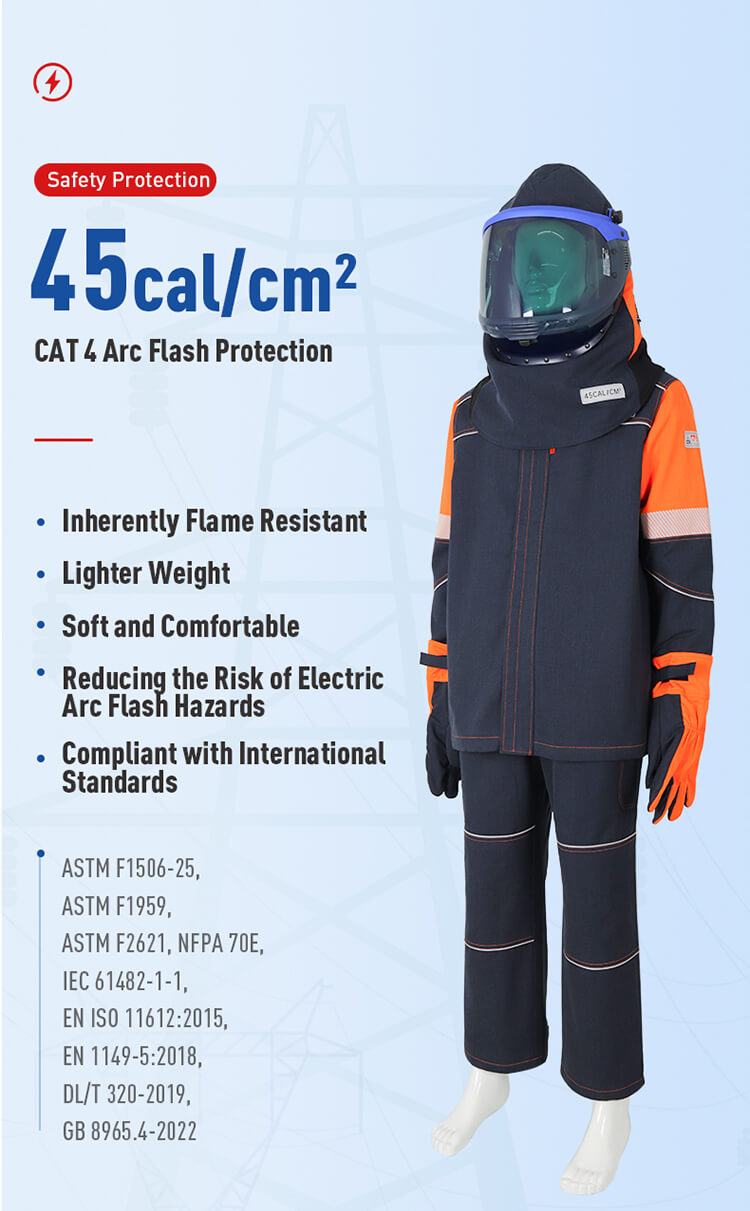
| Outer layer | Provide the arc rating, shed heat and resist abrasion | ArcPro® arc flash suit — jacket and trousers, bib overalls, coverall or robe, with hood, gloves and leggings as required |
The outer layer carries the arc rating. The inner layers do not add protection against the arc, but they can destroy it: a meltable base layer turns a survivable exposure into a serious burn, and a bulky mid layer that compresses the outer shell removes the air gap the rating assumes.
Heat is the reason most arc flash suits get unzipped, hoods get lifted and jobs get postponed to the afternoon. The answer is lighter, not fewer, layers.
One moisture-managing base layer only. An aramid or FR cotton short-sleeve shirt is enough under an 8–12 cal suit. Skip the singlet; two thin layers trap more heat than one.
Lighter outer fabric where the rating allows. If the study calls for 8 cal, do not issue a 40 cal suit “to be safe”; the wearer will pay for it in heat stress.
Ventilation over exposure. Open a vent, not the jacket. If the suit has to be opened to be tolerable, the configuration is wrong for the task.
Cooling that does not melt. Phase-change cooling vests designed for arc-rated systems are worn over the base layer and under the suit. A sports cooling towel or a plastic ice-pack vest is not a substitute.
Fluid and work-rest cycles. A 40 cal suit in direct sun is a physiological load. Plan hydration, shade and rotation before the shift, not after the first dizzy spell.
For long hot-weather tasks, a dedicated cooling vest such as the TemPro-CV-08 PCM vest is more effective than thinning the suit, because it removes heat without touching the arc rating. See our note on PCM cooling vests for high-temperature work.
Winter is where layering goes wrong most often, because the most effective insulators in a wardrobe are synthetic: puff jackets, fleece mid-layers, thermal leggings, synthetic base layers. All of them are the wrong answer under a suit.
Replace the puff jacket with an FR liner. A quilted arc-rated liner worn under the suit gives comparable warmth without introducing meltable fill.
Size for the layering. A suit bought for summer measurements will compress over a winter liner, which removes the air gap and restricts movement. Measure over the full layering system — our sizing guide explains how much allowance to add.
Keep the extremities consistent. Wool socks, not synthetic athletic socks; leather or arc-rated footwear; a hood that still seals over a beanie — and the beanie must be non-melting.
Watch the wet. Wet insulation loses performance. If the outer shell is soaked, the wearer is both colder and less protected until it dries.
Where a site runs one suit all year, the practical solution is a lighter suit plus an FR mid layer in winter, not a heavy suit in summer. That keeps the arc rating matched to the task and the heat load matched to the season.
No — and yes. The arc rating belongs to the outer garment or garment system that was tested. Adding a cotton t-shirt does not increase the ATPV printed on the label. But the effective protection of the wearer changes, in both directions:
It improves when a non-melting base layer keeps molten fabric away from skin and when the layering preserves the air gap.
It degrades when a meltable layer is introduced, when the mid layer compresses the shell, or when extra bulk opens a gap at the cuff, collar or waist.
For that reason, layering should be written into the risk assessment alongside the cal rating. “ArcPro® 12 cal suit, arc-rated base layer, no meltable underlayers” is a specification. “Arc flash suit” is not.
| Item | Guidance |
|---|---|
| T-shirt | FR cotton or aramid; crew neck; no printed plastisol graphics, which can melt |
| Underwear | Cotton or wool; avoid elastane blends and synthetic sports underwear |
| Socks | Wool or cotton; avoid synthetic athletic socks inside arc-rated boots |
| Trousers | Arc-rated trousers under a robe or coverall, or non-melting work trousers; no synthetic stretch chinos |
| Head and neck | Non-melting balaclava or hood liner; no synthetic cap under the hood |
| Accessories | Remove watches, synthetic lanyards and plastic badges from under the suit |
The printed-graphic point catches people out. A large plastisol print on a cotton shirt is a layer of PVC sitting on a non-melting fabric, and it behaves exactly like the synthetic layer the rule is trying to exclude.
Base layers should be washed with mild detergent and no fabric softener, because softener coatings reduce wicking and can leave a flammable residue. Wash FR base layers separately from oily workwear and never with chlorine bleach. Store them with the suit, not in a separate locker, so that a wearer cannot put on the suit and discover there is nothing compliant underneath.
For the outer garment, our arc flash suit care and inspection guide covers laundering, repair limits and retirement criteria in detail.
State the layers by fabric, not by garment name: aramid knit base layer, FR fleece mid layer, ArcPro® outer suit.
Ban meltable fibres explicitly, including sportswear, thermal underwear and printed graphics.
Give a summer and a winter configuration, and say which one the sizing was based on.
Provide the base layers as issue items; if crews supply their own, they will supply polyester.
Include layering in the pre-use inspection, because a suit that fits over a t-shirt will not close over a liner.
Yes, provided it is 100% cotton or another non-melting fibre and carries no synthetic print or stretch panel. An arc-rated base layer is better because it also resists ignition, but plain cotton is acceptable where the standard allows non-arc-rated non-melting underlayers.
Yes. Polyester melts at around 250 °C, far below the temperatures reached in an arc exposure. The melted polymer adheres to skin and produces deeper burns than the same exposure would without it.
Not necessarily, but it must be non-melting. Cotton and wool are acceptable. Where the risk assessment calls for a full arc-rated system, arc-rated underwear removes the judgement call entirely.
Only a vest designed for that use — worn over the base layer, with no meltable outer fabric and no exposed plastic against the skin. It must not compress the suit or block a vent.
Yes. Measure over the layers that will actually be worn, and specify winter measurements separately if the same crew works all year in a cold climate.
If you are standardising a layering system across a site, send the requirement to the C&G team. We can match base layers, mid layers and ArcPro® outer garments as a single system, and supply the fabric and standard documentation that the specification needs. The full arc flash protective clothing range covers 7.5 to 67 cal/cm² in jackets, trousers, bib overalls, coveralls, robes, hoods, gloves and leggings.

Shanghai C&G's personal protective clothing and PPE products are trusted by customers in the world. Our products are exported worldwide, with a strong presence in the United States, China, Japan, Germany, the United Kingdom, India, France, Italy, Brazil, and Canada. In addition, we have a significant customer base in other countries across each continent, including Australia, New Zealand, South Africa, Nigeria, and Egypt in Africa; Argentina, Chile, and Mexico in South America; Russia, South Korea, and Indonesia in Asia; Spain, Poland, and Turkey in Europe; and Saudi Arabia and the United Arab Emirates in the Middle East. Wherever you are in the world, we have the products you need to stay safe and protected. Contact us today to learn more about our products and how we can help you meet your safety needs.










Shanghai C&G is committed to building a leading brand in the safety emergency industry with technological innovation as the core and sustainable development, providing customers with one-stop safety emergency solutions, escorting the safety of customers, and make the world safer!
Building 39, Lane 123, Shenmei Road, Pudong New District, Shanghai, China
inquiry@cgprotection.com
+86-21-38214394


© 2023 Shanghai C&G. All Rights Reserved.