Shanghai, China
+86-17317656853
inquiry@cgprotection.com

Renewable energy sites have imported a familiar hazard into an unfamiliar layout. A battery container, a PV combiner box or a wind turbine converter cabinet concentrates high fault energy in a small space, often with one exit and no room to step back. The arc flash study may be complete, but the PPE specification is frequently copied from a thermal power station and no longer fits the task.
This guide covers how arc flash risk differs across solar, battery energy storage and wind sites, how to translate the study into an arc flash suit specification, and the practical details — escape routes, DC hazards, heat and remote-site maintenance — that decide whether the PPE actually works.
Three differences matter more than the headline voltage.
Direct current. PV strings and battery racks produce DC arcs that do not self-extinguish at a current zero crossing. A DC arc can sustain at lower current and for longer than the equivalent AC fault, which changes both incident energy and the time available to react.
Stored energy. A battery system can feed a fault from thousands of cells independently of the grid. Locking out the AC side does not remove the DC source; the available fault current is present until the rack is isolated.
Confined layouts. Containerised equipment and nacelles limit movement, so the working distance in the study may not match the distance a technician can actually keep. When the escape route is a single door behind you, the boundary assumptions deserve a second look.
Most PV arc flash work happens in three places, and each needs a different level of protection.
| Task | Typical exposure | Practical PPE |
|---|---|---|
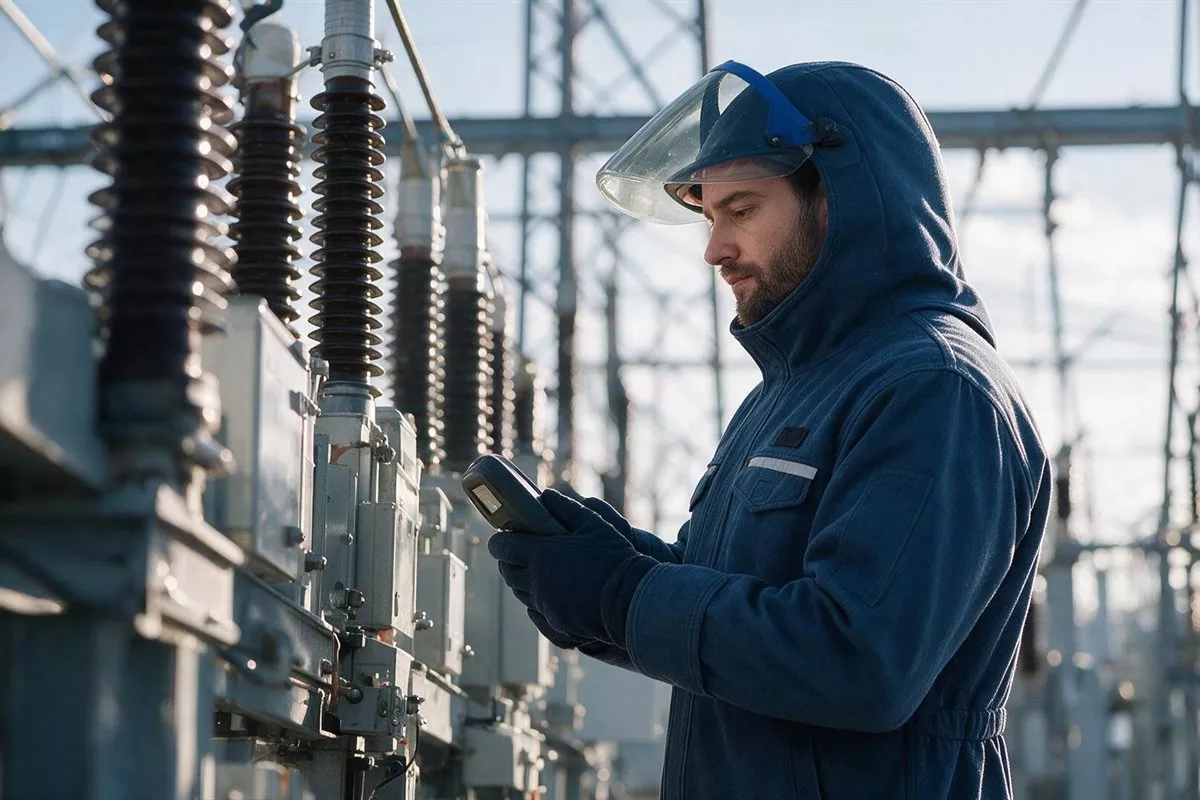
| String testing, IV curve tracing at combiner boxes | DC voltage present, low available energy but live conductors | Arc-rated daily wear or 8 cal suit with gloves and face protection; no meltable layers |
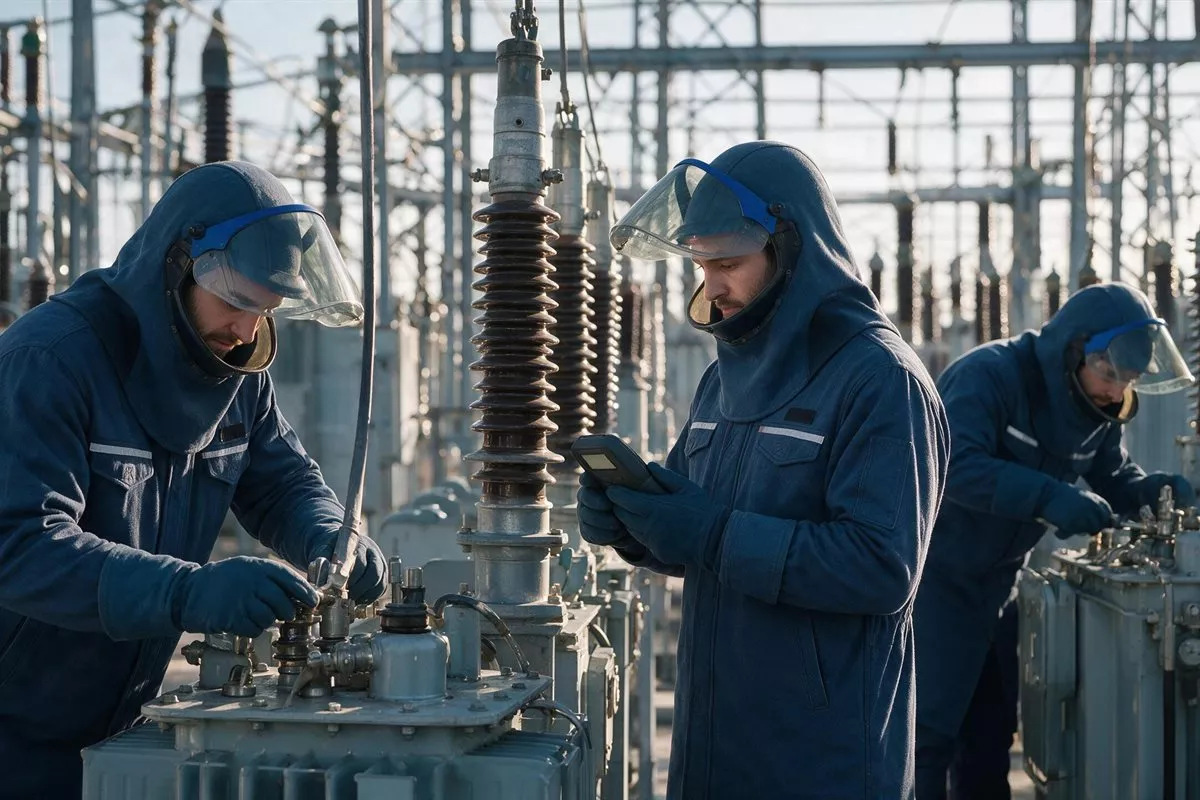
| Inverter service, filter and capacitor work | Stored DC energy, high current paths | Rating from the study, usually 8–25 cal; hood and arc-rated gloves for open-door work |
| MV transformer and switchgear operation | Highest incident energy on the site | 25–40 cal suit or robe with hood, plus switching gloves rated for the voltage |
Two PV-specific points are worth writing into the procedure. First, modules cannot be switched off: a string is live whenever there is light, so “isolated” means isolated at the combiner, not at the roof. Second, DC test instruments and their leads must be rated for the string voltage; a meter failure inside a live combiner is an arc flash event with the technician at arm's length.
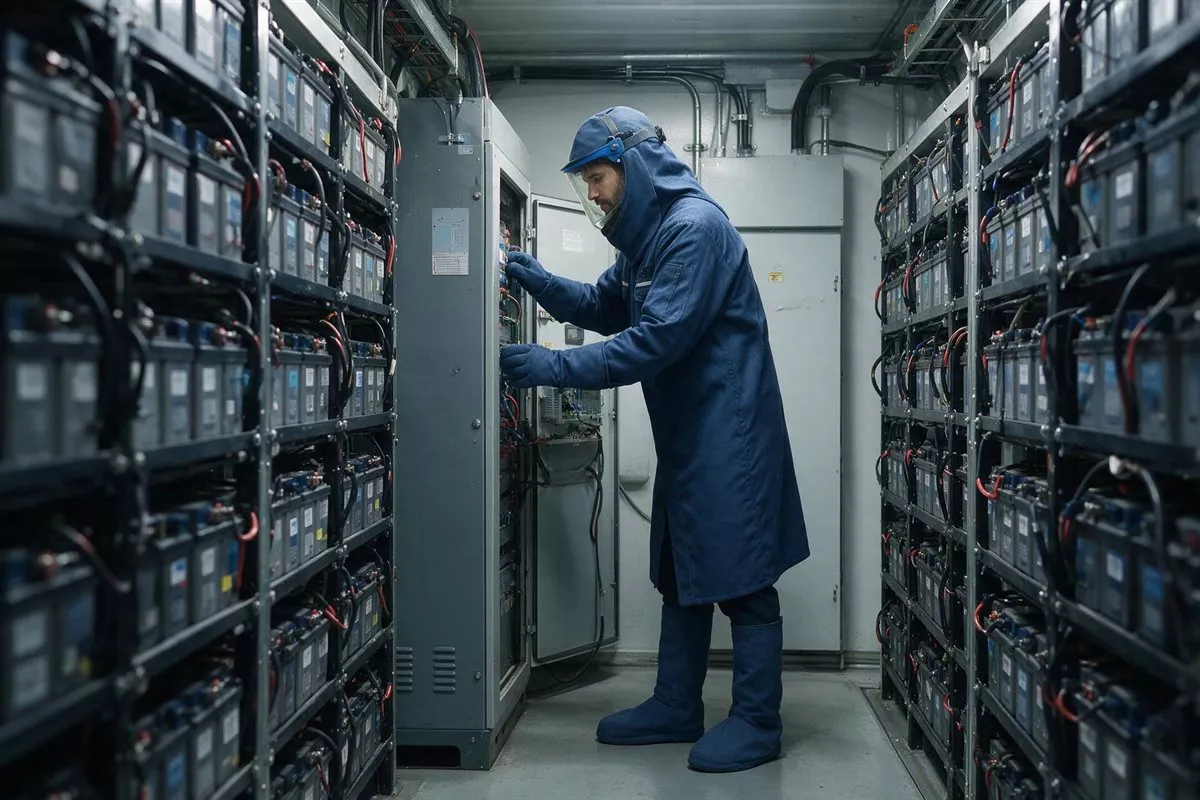
A containerised BESS combines high DC fault current, a confined space and a chemistry that can produce flammable and toxic gas. PPE selection has to cover the arc hazard set by the study, but the working method has to cover everything else.
Rack-level work is DC work. Racks commonly operate in the 1000–1500 V DC range, and the arc is fed by the battery itself. Treat the rack as energised until it is physically isolated and proven.
Arc duration drives the rating. Protection settings and clearing time matter as much as fault current. Where the DC protection is slow, the required cal rating rises quickly, which is where 40 cal suits and above become realistic rather than excessive.
Escape and egress. A 40 cal suit is heavy and restrictive. In a container with a single door, the wearer needs a route they can follow without turning around, and a colleague outside who can act.
Gas and thermal runaway. Arc-rated clothing is not gas protection. If the risk assessment includes off-gassing or thermal runaway, respiratory protection and gas detection belong in the same procedure.
For BESS work, the configuration is often a robe or a long coat over arc-rated trousers rather than a one-piece coverall, because it can be donned at the container door and removed quickly on exit. A coverall is the better choice where the work involves kneeling or crawling between racks, provided it is sized for the movement.
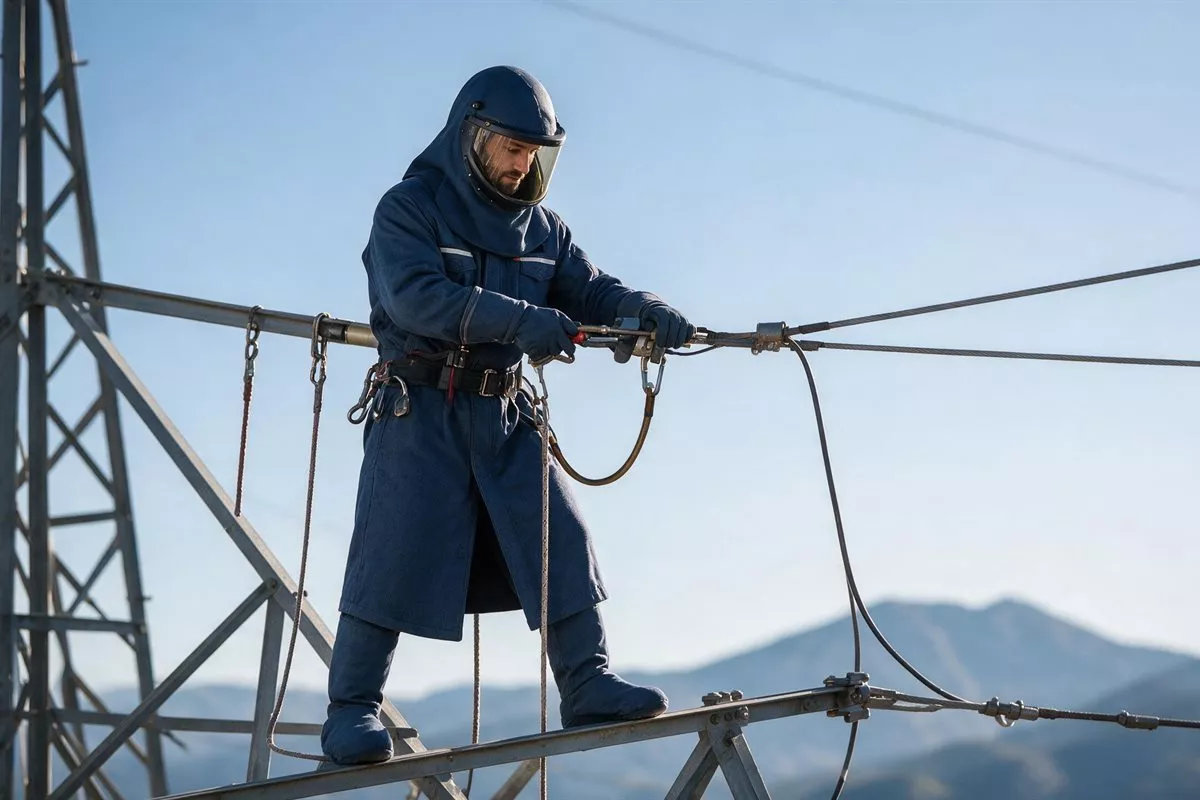
Onshore and offshore turbines add two constraints that land-based substations do not have: the wearer may be 80 metres up a tower, and the working space is a nacelle a few metres long.
Weight is a safety issue, not a comfort issue. Climbing in a 40 cal suit raises heart rate and reduces grip strength. Where the study permits 8–12 cal for converter checks, do not issue 40 cal “for consistency”.
Donning time. A hood and face shield stored in a nacelle must be reachable before the cabinet is opened. If the kit lives in a bag at the tower base, it will not be worn.
Humidity and salt. Offshore turbines keep clothing damp. Arc-rated rainwear worn as an outer layer protects the suit and keeps the wearer dry; a soaked suit loses insulating performance.
Rescue and egress. Restricted space plus restrictive PPE is a combination that needs a rescue plan, not only a PPE order.
Whatever the generation type, the specification follows the same five lines. State the arc rating and the standard, the configuration, the coverage, the accessories and the layering rule.
| Specification line | What to write |
|---|---|
| Arc rating | ATPV or EBT in cal/cm², with the governing standard (ASTM F1959, IEC 61482-1-1) and garment standard (IEC 61482-2) |
| Configuration | Jacket and trousers, bib overall, coverall or robe, with the task list it applies to |
| Coverage | Hood type, face shield, arc-rated gloves, leggings or boot covers — rated for the same task |
| Layering | Non-melting or arc-rated base layer; no synthetic mid layers |
| Environmental | Arc-rated rainwear, high-visibility trim, antistatic requirement if the site handles gas |
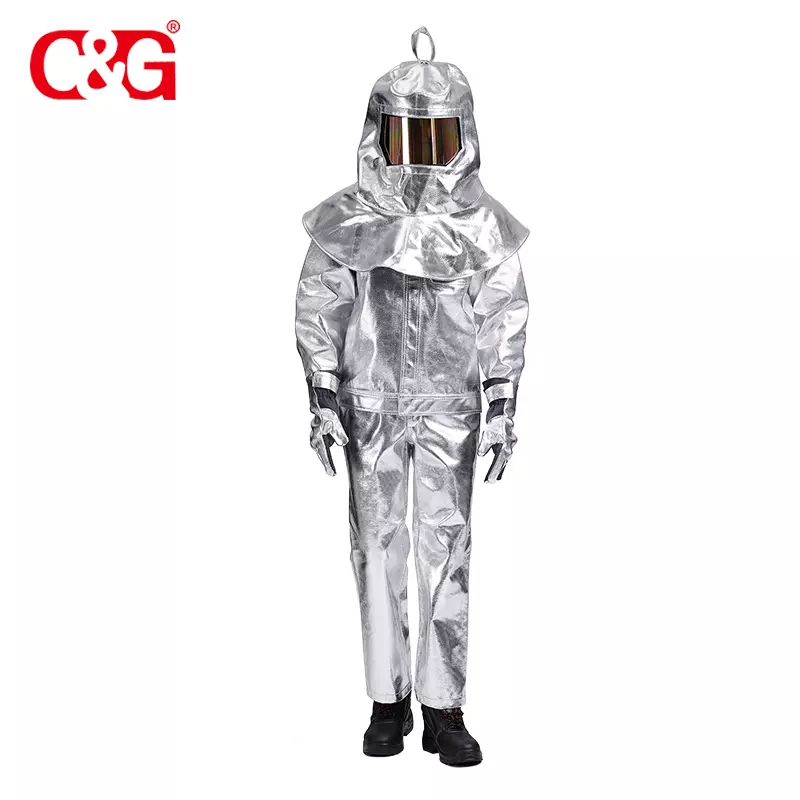
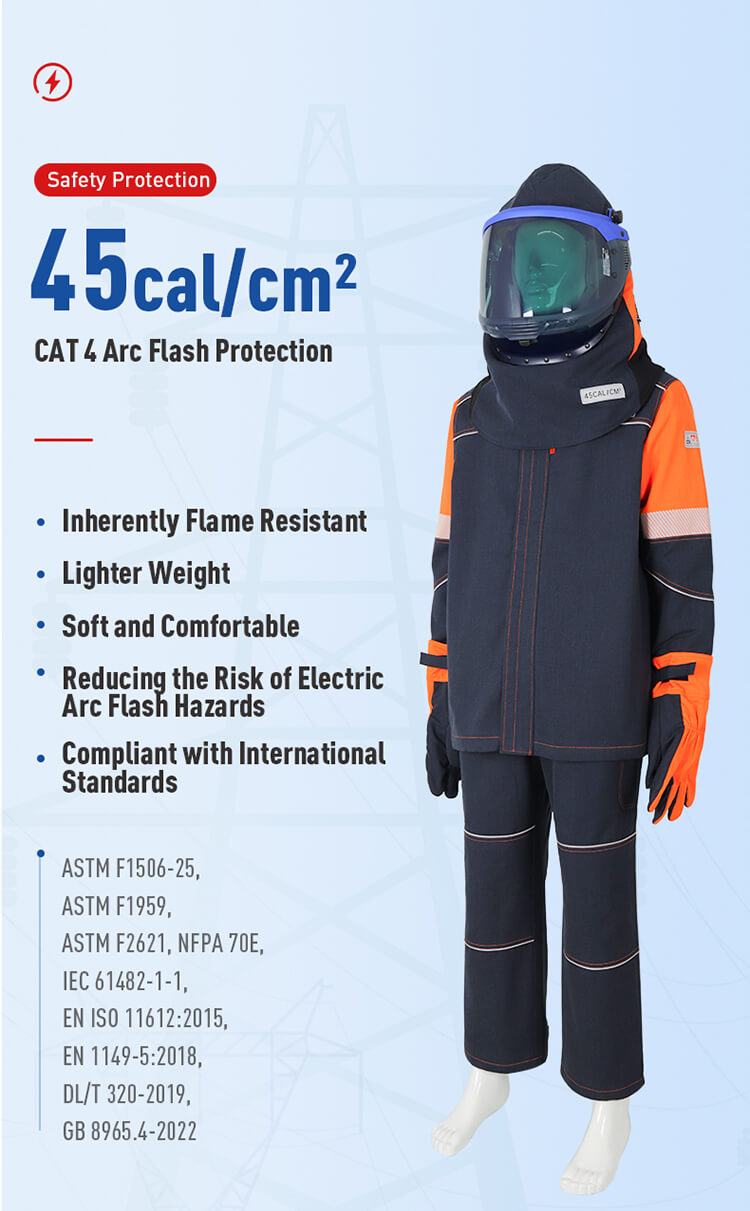
The C&G ArcPro® range covers this matrix from 7.5 to 67 cal/cm² with jacket, trouser, bib, coverall, robe, hood, glove and legging components, in inherent FR fabric that keeps its performance through washing. Where a site needs different ratings for different tasks, colour-coded kits with clear labelling stop the wrong suit being taken to the wrong cabinet — a point we cover in the custom arc flash suit specification guide.
Solar sites tend to be hot, BESS containers are poorly ventilated and nacelles are enclosed. The physiological load of a high-calorie suit is the most common reason a suit gets opened in service, and an open suit is worse than a lower-rated closed one.
Match the rating to the task and record why the lower rating is acceptable, so the decision survives an audit.
Use cooling that does not compromise the system. PCM cooling vests worn over the base layer and under the suit are established practice for hot-weather electrical work; see our cooling vest note.
Plan work-rest cycles for high-calorie tasks, and schedule BESS rack work outside the hottest part of the day where the switching programme allows.
Keep fluids on site — remote PV and wind sites rarely have a canteen within reach.
PPE that is inspected once a quarter in a depot will be inspected never on a solar farm 300 km from the warehouse. The workable model is a small, disciplined kit per technician: a suit, hood, gloves, spare base layer, a laminated inspection card and a marker for tagging defects.
Our arc flash suit inspection and care guide sets out the check points; on remote sites the practical additions are a dry storage bag, a spare face shield and a rule that any suit exposed to an arc is quarantined on site and returned, not reused. Arc-rated rainwear needs the same discipline: it is the layer most likely to be stored wet and the layer most likely to be borrowed by someone who is not doing electrical work.
Fabric test report to ASTM F1506-25.
Arc test report to ASTM F1959 and IEC 61482-1-1 for the garment, not only the fabric.
Garment standard declaration to IEC 61482-2 or EN 61482-2.
Antistatic evidence to EN 1149-5:2018 where the site requires it.
Care label and laundering instructions that match the test conditions.
Yes. Incident energy depends on fault current, clearing time and working distance, not on the nominal voltage alone. Many PV DC faults occur at string or combiner level where the available energy is modest but the conductors are live and the technician is close.
A DC arc does not pass through a current zero, so it can sustain until the circuit is physically interrupted. Protection settings and clearing times differ, which is why the incident energy calculation must use a DC method rather than an AC one.
It comes from the study. Rack voltage, available fault current and DC protection clearing time together determine the incident energy, and the required rating can range from 8 cal to 40 cal or more across different designs.
Only if the highest rating is acceptable for every task. In practice, sites usually keep a lighter suit for routine inspection and a higher-rated kit for rack, cabinet or switchgear work, with clear labelling so the two are never confused.
Where work continues in wet conditions, yes. A wet suit loses insulating performance, and a non-arc-rated rain shell over an arc-rated suit adds a meltable layer exactly where the arc is closest.
If you are specifying PPE for a solar, storage or wind portfolio, send the site list and the study results to C&G and we will map ratings, configurations and accessories task by task. The ArcPro® arc flash range and the solar and renewable energy PPE page set out the components, and our team can supply the test documentation each site needs for its safety file.
Tags: arc flash suit, solar, BESS
Shanghai C&G's personal protective clothing and PPE products are trusted by customers in the world. Our products are exported worldwide, with a strong presence in the United States, China, Japan, Germany, the United Kingdom, India, France, Italy, Brazil, and Canada. In addition, we have a significant customer base in other countries across each continent, including Australia, New Zealand, South Africa, Nigeria, and Egypt in Africa; Argentina, Chile, and Mexico in South America; Russia, South Korea, and Indonesia in Asia; Spain, Poland, and Turkey in Europe; and Saudi Arabia and the United Arab Emirates in the Middle East. Wherever you are in the world, we have the products you need to stay safe and protected. Contact us today to learn more about our products and how we can help you meet your safety needs.





Shanghai C&G is committed to building a leading brand in the safety emergency industry with technological innovation as the core and sustainable development, providing customers with one-stop safety emergency solutions, escorting the safety of customers, and make the world safer!
Building 39, Lane 123, Shenmei Road, Pudong New District, Shanghai, China
inquiry@cgprotection.com
+86-21-38214394


© 2023 Shanghai C&G. All Rights Reserved.