Shanghai, China
+86-17317656853
inquiry@cgprotection.com

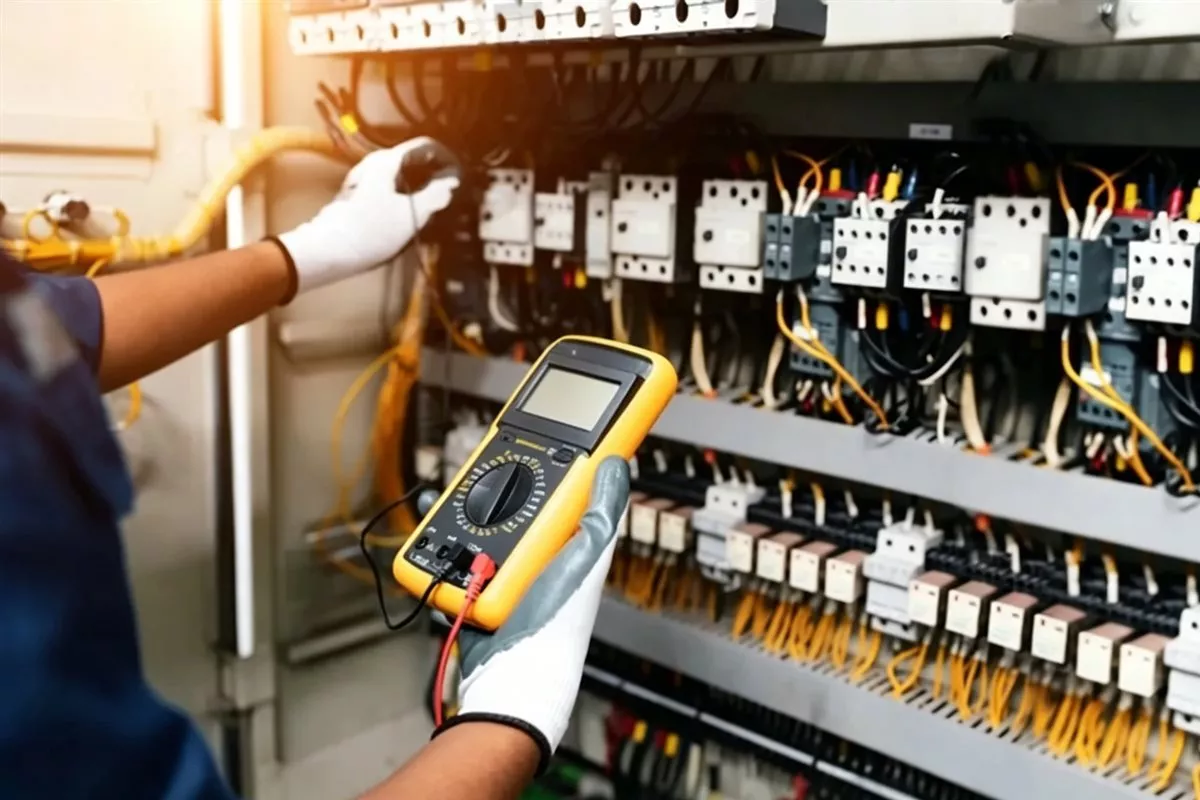
Every arc flash incident has a moment when the distance closes. For a linesman it is the moment the conductor is approached; for an electrician it is usually the moment a probe touches a terminal. Testing, fault-finding and verification are the tasks in which hands, face and torso are closest to live parts, and they are the tasks most often performed with the panel open, the suit partly unzipped and a meter that was chosen for its price rather than its category.
Arc flash PPE for electrical testing is not only the suit. It is the instrument, the leads, the probes, the gloves and the procedure that decides where the tester stands and which hand does the work. This guide covers the parts of that system that are most often specified wrongly, and the checks that turn a toolbox of test gear into a defensible testing procedure.
Switching is planned, scripted and usually performed with the remote handle or the cubicle door between the operator and the busbar. Testing is different in four ways:
The enclosure is open. Voltage verification, phase rotation, insulation resistance and thermography all require access to parts that are normally behind a barrier.
The hand is the tool. A probe has to be placed with millimetre accuracy inside a space where a slip is a short circuit.
The hazard is not switched off. Much testing is done precisely because the circuit is live and its state is unknown.
It happens often. A switching task may occur once a shift; a voltage check occurs at every isolation, every fault call and every panel survey.
The consequence is that the PPE decision cannot be made once for "electrical work" and reused. It has to be made for the testing task itself, using the incident energy at the point where the probe will be, not at the point where the operator normally stands.
A meter that fails violently is an ignition source in the hand. IEC 61010 defines measurement categories by the transient energy available at the point of measurement, and the category marked on the instrument is a limit, not a suggestion.
| Category | Where it applies | What it means in practice |
|---|---|---|
| CAT II | Appliances and portable equipment plugged into a socket | Not suitable for fixed distribution or panel work |
| CAT III | Distribution boards, feeder circuits, motor control centres, fixed installations | The minimum category for most industrial panel testing |
| CAT IV | Origin of the installation, service entrance, outdoor conductors, meters and primary overcurrent devices | Required at the supply side, where transient energy is highest |
Two rules follow. First, the category must match the highest point the probe will reach, not the point where the meter is held — the lead is an extension of the instrument, and the transient arrives through it. Second, the voltage rating must cover the system voltage with margin; a CAT III 600 V meter on a 690 V system is outside its rating even though it displays a number.
Where the site standard permits it, choose a meter with a non-contact voltage detector and a built-in lead resistance check, and record the model on the test procedure so that a substitute from the stores does not quietly downgrade the category.
Leads are replaced more often than meters and are far more often out of specification. The failure modes are consistent:
Category mismatch. A CAT IV meter fitted with CAT II leads is a CAT II system. The lowest-rated component sets the rating.
Exposed metal. Long, unshrouded probe tips that leave most of the tip live. Finger guards and shrouded tips exist for a reason.
Cracked insulation. A lead that has been coiled around the meter, shut in a case or frozen in a van will crack at the strain relief before it fails visibly at the tip.
Fuse substitution. A blown high-energy fuse replaced with a glass fuse of the same physical size removes the protection the meter was designed around.
Wrong length. Leads long enough to reach across a cubicle also allow the tester to stand further from the arc — but only if the procedure tells them to.
Inspect leads before every use: flex the cable along its length, look for cracks and discoloration at the strain relief, check the shrouds for splits, and confirm the CAT marking is legible. A lead without a legible category marking is retired, because its rating can no longer be verified.
Testing is hard on gloves. The same pair that is comfortable for racking a breaker is asked to feel a 4 mm terminal through a probe tip, and the result is often a glove that is too thin for the voltage or a glove that has been cut to improve feel.
Rubber insulating gloves are selected by system voltage and worn under leather protectors or arc-rated overgloves. The class table, the air test and the retest interval are set out in our guide to arc flash gloves and insulating glove classes. Three points apply specifically to testing:
Do not use a lower class for dexterity. If the task cannot be performed in the correct class, change the task — use a remote probe, a longer lead or a different instrument — rather than the glove.
Protectors stay on. The leather protector is what stops the rubber being punctured by a panel edge or a probe. It also reduces the chance of the rubber being contaminated by flux, oil or battery electrolyte.
Check after every session. Probing around terminal blocks abrades the fingertips. A glove that passes the air test in the morning can fail it after an afternoon in a cabinet full of sheet-metal edges.
Infrared surveys are usually performed with the equipment energised and the enclosure open, which places the thermographer inside the arc flash boundary with a camera held at face height. The camera does not reduce the hazard, and the scan pattern often means the body is closer to the busbar than during a switching operation.
Practical controls for survey work:
Scan through IR windows where they exist. A window keeps the enclosure closed and removes most of the exposure; where windows are not fitted, the survey becomes a planned open-panel task with its own risk assessment.
Dress for the calculated energy at the open panel, including hood and face shield where the assessment requires it, not merely the daily-wear arc-rated shirt.
Work in pairs. One person scans while the other maintains the boundary and can isolate. A thermographer looking at a screen is not watching their footing or the door of the adjacent cubicle.
Do not open covers to "get a better image". If the cover must come off, the task has changed and the PPE decision has to change with it.
The same logic applies to partial discharge surveys, power quality logging and relay commissioning: the instrument is only one part of the exposure, and the enclosure state is what usually decides the PPE level.
Voltage verification is the task where procedure matters more than equipment. The accepted sequence is: test the instrument on a known live source, test the circuit to be worked on, then test the instrument again on the known source. The first test proves the meter works, the second proves the circuit is dead, and the third proves the meter did not fail during the second test.
Temporary protective grounds are part of the same control. They are installed with a live-line tool or with gloved hands, depending on the procedure, and they are rated for the fault current and the duration the site expects. A grounding set chosen for fit rather than for fault duty is not a control.
Where the task involves proving dead at the supply side, the PPE level is set by the incident energy at that point, which is frequently the highest on the site. It is not unusual for a five-second voltage check at the main switchboard to require a higher category than an hour of work downstream.
The arc rating comes from the incident energy study, adjusted for the working distance that the task actually creates. A tester leaning into a cubicle is closer than the standard working distance, and the incident energy rises as distance falls. Three practical consequences:
Use the task-based PPE category, not the equipment label alone. The label often quotes the value at a nominal working distance; the task may put the head and hands closer.
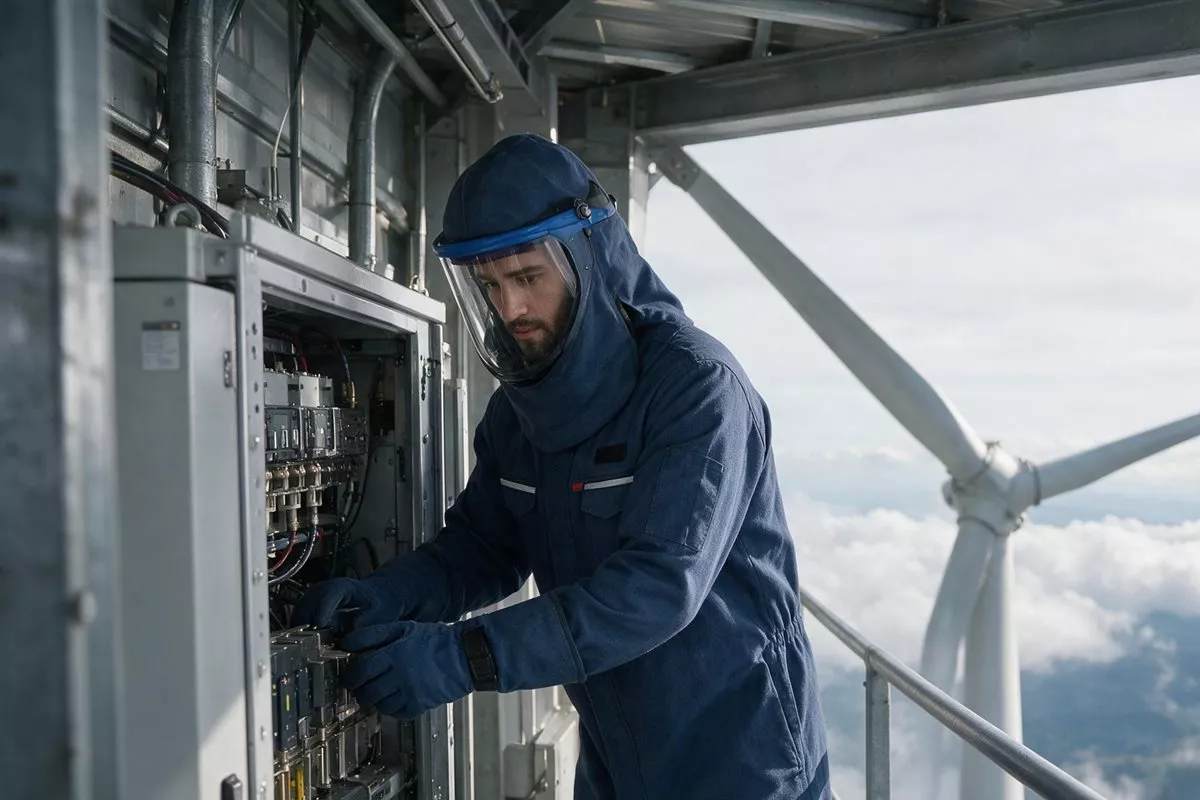
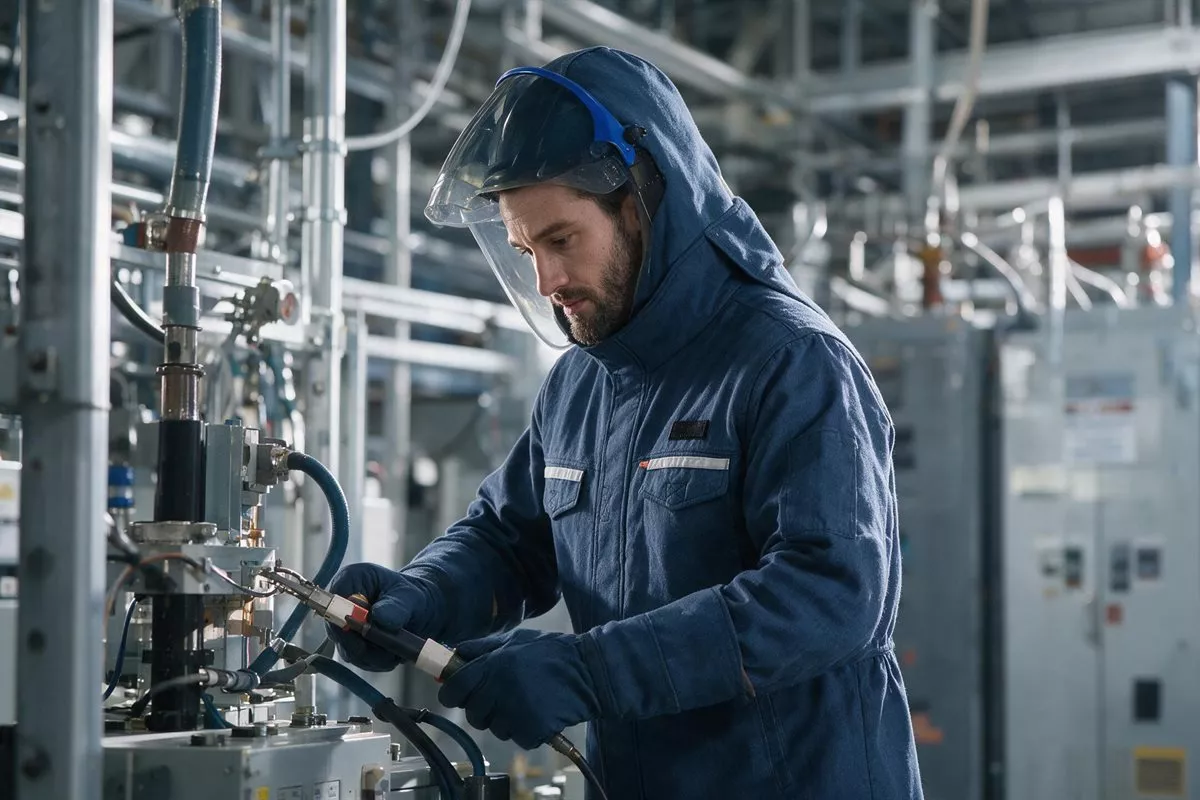
Cover the head. Testing is a face-forward task. A hood or arc-rated face shield with a balaclava is appropriate whenever the calculated energy exceeds the level at which the face is at risk.
Match the whole system. A 40 cal suit worn with an 8 cal face shield is an 8 cal system at the face. Our guide to arc flash suit protection levels explains how the category maps to garment sets and where the weak points appear.
Where the assessment shows that the testing task itself carries high energy, the better answer is often to change the task: install remote monitoring, use a maintenance-free test point, or perform the check with the equipment de-energised and proved dead by a different method. PPE is the last line of defence, not the first choice.
Test gear lives in vans, on belts and in cabinets, and it is inspected far less often than the clothing worn beside it. A workable routine:
Before each use: leads flexed and inspected, shrouds intact, category marking legible, meter case and display undamaged, battery compartment secure.
Monthly: calibration status checked, fused leads confirmed with the correct fuse type, insulation testers and their leads checked for cracks.
Annually: calibration and a functional check against a reference source, recorded against the instrument serial number.
After any incident or drop: the instrument is removed from service until it has been inspected and, where necessary, recalibrated. A meter that has been dropped on a concrete floor may still read correctly and no longer be safe.
Store meters and leads separately from oils, solvents and battery acid, and do not leave them in a vehicle over a weekend in direct sun or in freezing conditions. Insulation becomes brittle with age and temperature cycling, and the damage appears first at the point where the lead bends.
The documents an auditor will ask for are simple, and most sites already have the raw information:
Task risk assessment naming the test, the equipment, the incident energy and the PPE selected.
Instrument list with model, CAT rating, calibration date and the serial numbers of the leads issued with it.
Glove register showing class, size, test date and next retest date.
Verification record showing the three-step prove sequence, signed by the person who performed it.
Training record confirming that the tester can interpret the meter's category and the label on the panel.
If those five documents exist and agree with each other, the testing procedure is defensible. If the meter in the van is CAT III, the leads are CAT II and the glove record is a year old, the paperwork will not save the outcome.
Yes, whenever the measurement point is inside an enclosure that could produce an arc. The meter reduces the risk of a short at the probe tip, but it does not protect the hand, face or torso from incident energy. The PPE level comes from the task risk assessment.
Usually yes for the load side of a distribution board, provided the leads are also CAT III and rated for the voltage. At the service entrance or the supply side of the main device, CAT IV is normally required. The category of the lowest-rated component applies.
No. The insulating glove class is set by system voltage, and a thinner glove does not provide the same dielectric protection. If dexterity is the problem, use a remote probe, a longer lead or a different test method.
It does when the enclosure is open and the equipment is energised. The camera does not reduce the hazard. Where IR windows are fitted and used, the exposure is substantially lower, but the site assessment should confirm the level for the specific survey.
On condition, not on a calendar. Replace any lead with a cracked sheath, a damaged shroud, an illegible category marking, a repaired tip or a blown fuse of the wrong type. In heavy use, expect to replace leads more often than meters.
If you are standardising testing PPE across a site, send the test tasks and system voltages to the C&G team. We can match insulating gloves, arc-rated overgloves and suit systems to the incident energy at the test point, and supply the documentation that a testing procedure needs. The full arc flash protective clothing range covers suits, hoods, gloves and kits for diagnostic work as well as switching.
Tags: arc flash testing, insulating gloves, arc rated clothing
Shanghai C&G's personal protective clothing and PPE products are trusted by customers in the world. Our products are exported worldwide, with a strong presence in the United States, China, Japan, Germany, the United Kingdom, India, France, Italy, Brazil, and Canada. In addition, we have a significant customer base in other countries across each continent, including Australia, New Zealand, South Africa, Nigeria, and Egypt in Africa; Argentina, Chile, and Mexico in South America; Russia, South Korea, and Indonesia in Asia; Spain, Poland, and Turkey in Europe; and Saudi Arabia and the United Arab Emirates in the Middle East. Wherever you are in the world, we have the products you need to stay safe and protected. Contact us today to learn more about our products and how we can help you meet your safety needs.










Shanghai C&G is committed to building a leading brand in the safety emergency industry with technological innovation as the core and sustainable development, providing customers with one-stop safety emergency solutions, escorting the safety of customers, and make the world safer!
Building 39, Lane 123, Shenmei Road, Pudong New District, Shanghai, China
inquiry@cgprotection.com
+86-21-38214394


© 2023 Shanghai C&G. All Rights Reserved.