Shanghai, China
+86-17317656853
inquiry@cgprotection.com


Hands are the part of the body that reaches into the hazard. A switching task that keeps the torso a metre from the busbar still puts a gloved hand on a lever, a tester probe or a rack handle. And yet the glove is the component most often selected by habit: whatever is in the stores, worn over whatever was worn yesterday.
Arc flash glove protection is not one garment. It is a system of two or three parts, each doing a different job, and the system fails if any part is chosen for the wrong reason. This guide explains the difference between rubber insulating gloves, leather protectors and arc-rated overgloves, how the classes map to voltage, how to size and inspect them, and how to write the requirement so that a stores catalogue cannot quietly substitute the wrong item.
An electrical glove has to do one of two things, and often both:
Insulate against shock. That is the job of the rubber insulating glove, tested to ASTM D120 or IEC 60903, classified by maximum use voltage. Nothing else in the system provides dielectric protection.
Protect against arc and flame. That is the job of the arc-rated outer layer — the leather protector and, where the suit rating demands it, an arc-rated overglove tested with the garment system.
The failure mode that shows up in incident reports is substituting one for the other. A leather protector worn on its own gives cut and abrasion resistance and no dielectric protection whatsoever. A rubber glove worn on its own against sharp sheet-metal edges lasts about a shift. Both mistakes are caused by treating the glove as a single item on a purchase order.
The class system is a maximum-use-voltage rating, not a recommendation. The figures below follow the C&G insulating glove range, which is available in the lengths shown; the standard classes run from 00 to 4.
| Class | Max use voltage (AC) | Typical length | Where it is normally issued |
|---|---|---|---|
| 00 | 500 V | 280 / 360 mm | Low-voltage distribution, panel work, testing |
| 0 | 1 000 V | 280 mm | LV switchgear, motor control, general maintenance |
| 1 | 7 500 V | 360 mm | MV distribution, ring main units |
| 2 | 17 000 V | 360 / 410 mm | 11–33 kV switching and substation work |
| 3 | 26 500 V | 410 mm | HV transmission and substation primary plant |
| 4 | 36 000 V | 410 mm | Highest-voltage live work |
Three rules follow from that table. First, the class must be selected from the system voltage, not from the arc rating of the suit: a 40 cal suit does not make a Class 00 glove acceptable on 11 kV. Second, the longer length is not a luxury — it provides the cuff overlap over the suit sleeve, and a short glove under a bulky suit sleeve leaves a gap at the wrist. Third, the class is a ceiling: a Class 2 glove on a 400 V panel is not "safer", it is thicker, less dextrous, and more likely to be taken off.
Leather protectors exist to stop mechanical damage, and they do it well enough that a rubber glove without one is considered a consumable rather than PPE. The specification points that matter:
Protectors should be tested to ASTM F696 or the equivalent, with a cut- and puncture-resistant palm.
They must not be shorter than the rubber glove. A trimmed protector exposes the rubber at exactly the point where it flexes most.
They must not be so thick that grip strength drops. A glove the wearer cannot close properly is a glove that will be removed at the worst moment.
They must be dry. A wet leather protector wicks contamination into the rubber and holds moisture against it between jobs.
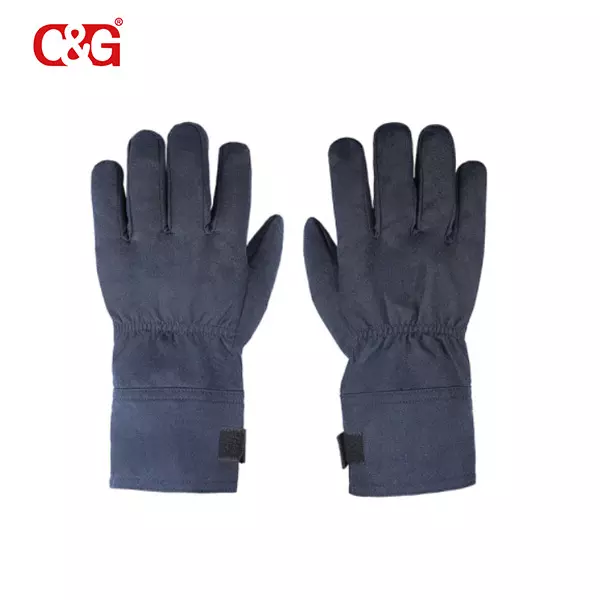
Leather protectors are not arc rated in the sense a suit is, but they must not melt, and they must not be treated with oils or conditioners that add fuel. Where the arc rating of the hand protection matters — typically class 3 and 4 suit work — a dedicated arc-rated overglove is used instead of, or over, the leather protector.
C&G supplies the ArcPro® glove series to match the suit ratings: ArcPro-GLV-12, -25, -40, -55 and -65, so that a 40 cal suit is not completed with a hand covering rated for 8 cal. The glove should be listed on the same line of the specification as the suit, because the arc rating of a system is set by its weakest component at the point of exposure.
Two practical points are worth building into the procedure:
Overlap, not abutment. The suit sleeve should cover the top of the glove cuff, or the glove cuff should cover the sleeve — never a butt joint at the wrist.
The tested combination. Where the supplier has arc-tested a glove with a specific suit construction, buy that combination. Mixing components from different systems is an assumption, not a rating.
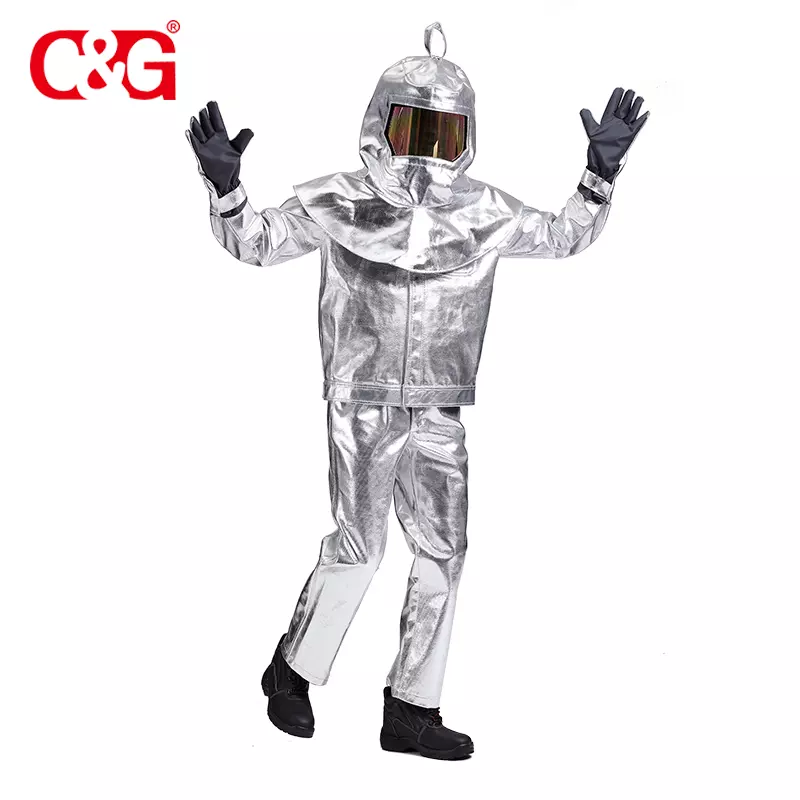
If the site issues complete kits, the glove is already matched; the 67 cal CAT 4 arc flash kit is an example of a system in which every component, including gloves and leggings, carries the same rating. Sites that buy components separately should read our note on why a complete arc flash suit system outperforms individual parts.
Glove sizing is not the same as clothing sizing, and a glove that is one size too large is a dexterity problem that turns into a safety problem. Measure two dimensions on the dominant hand:
Hand circumference around the palm, just below the knuckles, without the thumb.
Hand length from the wrist crease to the tip of the middle finger.
Match both to the manufacturer's chart rather than to a remembered size, and measure again if the crew member changes glove class: a Class 2 glove in the same nominal size fits differently from a Class 00. Arc-rated overgloves are sized to be worn over the protector, so they run larger than a bare-hand glove. Our arc flash suit sizing guide covers the same principle for the garment: measure over the layers that will actually be worn.
Rubber gloves are inspected before every use and electrically retested on a schedule. The pre-use check has four parts:
Visual. Cuts, punctures, embedded foreign objects, ozone cracking at the cuff, swelling, hardening or a glossy, tacky surface. Check the inside as well as the outside.
Air test. Trap air by rolling the cuff tightly toward the fingers, then watch for the glove to inflate and hold, and listen and feel for escaping air along the fingers and palm.
Marking. Class, size, test date and the next retest date legible on the glove or its record.
Protector. Clean, dry, no cuts through the palm, no oil contamination, correct length relative to the rubber glove.
The air test catches holes. It does not catch contamination, ozone degradation or a glove that has been stored under a solvent drum for a year, which is why the visual and the retest both matter. Common practice, consistent with ASTM F496 and OSHA 1910.137, is electrical retesting every six months for gloves in service and every twelve months for gloves held in storage, with the date recorded against the glove rather than the wearer.
Rubber is damaged by ozone, sunlight, heat, oil, grease and solvent, and by being folded or compressed in a toolbox. Store gloves flat or loosely rolled in a cool, dark, dry place, away from electric motors and welding equipment, and keep them in their own bag rather than loose in a van with hydraulic fluid. Talc or a manufacturer-approved dusting powder prevents the surfaces sticking; petroleum-based products destroy the rubber.
A glove contaminated with oil or solvent is retired, not cleaned. The contamination migrates into the rubber, and the damage is invisible until the glove is under load.
Leather protectors are not washed; they are brushed clean, dried away from direct heat, and retired when the palm thins or cracks. Arc-rated fabric overgloves follow the same rules as the suit: mild detergent, no bleach, no fabric softener, no solvent, low-temperature drying. Our arc flash suit care and inspection guide sets out the laundry rules in full, and they apply to the glove as much as to the jacket.
A specification that survives a stores catalogue looks like this:
Rubber insulating glove: class (from system voltage), length, standard (ASTM D120 / IEC 60903), test interval, and the record system that holds the retest date.
Protector: ASTM F696, leather, correct length relative to the rubber glove, no oil treatment.
Overglove: arc rating matched to the suit, listed with the suit on the same order line.
Sizing: measured, not assumed, with the size recorded per wearer.
Retirement: cuts, contamination, failed air test, failed retest, or an illegible test date.
Where gloves are issued from a pool, tag each pair and log the issue. Where they are personally issued, keep the retest date on the glove bag so that the wearer sees it every morning. Either way, the record is what makes the six-month interval real.
Only where the task requires arc protection but no shock protection — for example handling an isolated but not yet proven circuit, or working near, rather than on, live parts. Any task that requires dielectric protection needs a rubber insulating glove of the correct class underneath.
Rubber insulating gloves are rated for voltage, not for incident energy. The arc rating of the hand protection comes from the arc-rated overglove and, where tested, from the complete glove system. That is why the overglove must be matched to the suit.
Common practice is every six months for gloves in service and every twelve months for gloves in storage, following ASTM F496 and the requirements of the authority having jurisdiction. The date must be recorded against the glove, not against the person who happens to hold it.
Small stitching repairs are acceptable if the palm integrity is unaffected. A cut through the palm, a hardened or oil-soaked protector, or one that has been shortened should be replaced — the cost of a protector is small compared with the rubber glove it is supposed to protect.
Usually ozone exposure, heat or a petroleum-based contaminant. Stiffness, swelling or a tacky surface are retirement criteria, not something to soften with powder. Check where the gloves were stored before replacing them, or the new pair will follow the same path.
If you are standardising hand protection across a site, send the voltage classes and task list to the C&G team. We can match rubber insulating gloves, protectors and ArcPro® arc-rated overgloves to your suit ratings, and supply the test documentation and retest schedule that an audit will ask for. The full arc flash protective clothing range includes the 50 cal leather arc gloves and every other component of the suit system.
Tags: arc flash gloves, rubber insulating gloves, arc rated clothing

Shanghai C&G's personal protective clothing and PPE products are trusted by customers in the world. Our products are exported worldwide, with a strong presence in the United States, China, Japan, Germany, the United Kingdom, India, France, Italy, Brazil, and Canada. In addition, we have a significant customer base in other countries across each continent, including Australia, New Zealand, South Africa, Nigeria, and Egypt in Africa; Argentina, Chile, and Mexico in South America; Russia, South Korea, and Indonesia in Asia; Spain, Poland, and Turkey in Europe; and Saudi Arabia and the United Arab Emirates in the Middle East. Wherever you are in the world, we have the products you need to stay safe and protected. Contact us today to learn more about our products and how we can help you meet your safety needs.











Shanghai C&G is committed to building a leading brand in the safety emergency industry with technological innovation as the core and sustainable development, providing customers with one-stop safety emergency solutions, escorting the safety of customers, and make the world safer!
Building 39, Lane 123, Shenmei Road, Pudong New District, Shanghai, China
inquiry@cgprotection.com
+86-21-38214394


© 2023 Shanghai C&G. All Rights Reserved.