Shanghai, China
+86-17317656853
inquiry@cgprotection.com

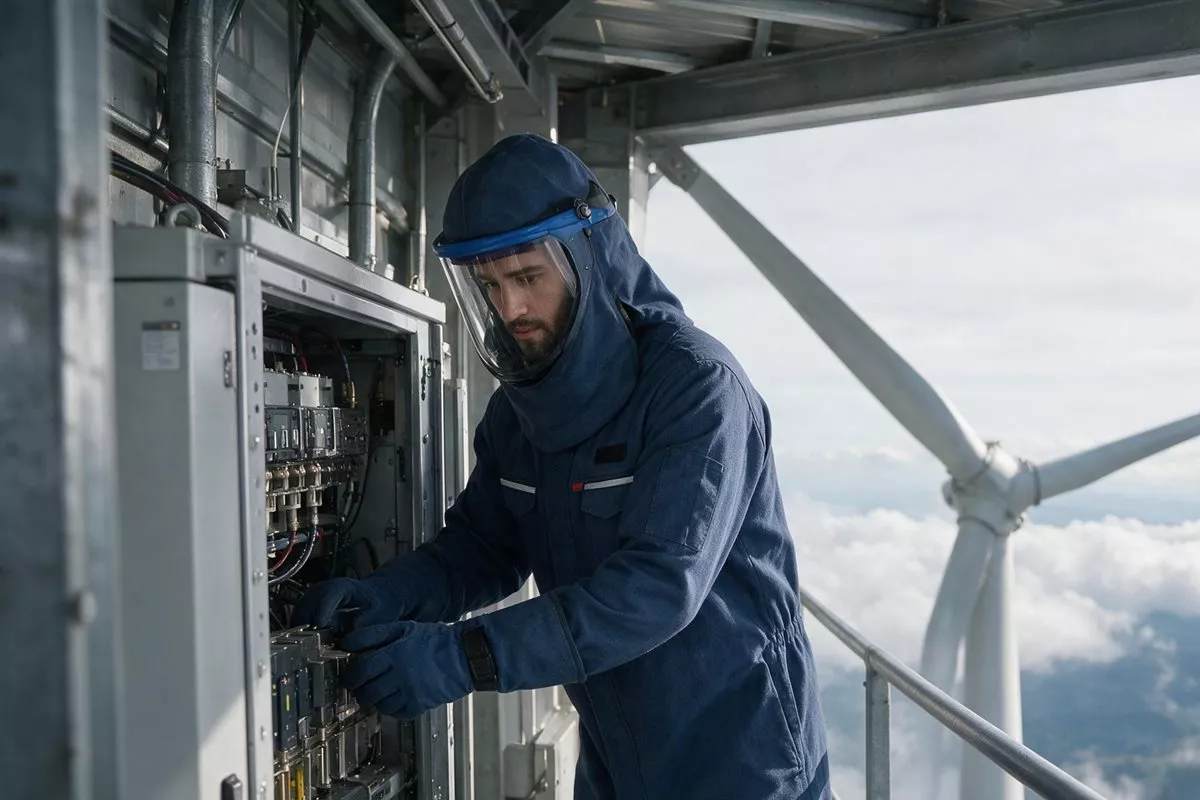
Cold weather does not suspend electrical work. Substations are switched in January, wind turbines are maintained in sleet, and solar farms are commissioned in frost. What changes is the way crews dress — and that is where an arc-rated clothing programme usually comes apart. A suit that fits and performs in June is worn over two extra layers in December, the hood is replaced by a wool hat, and the gloves are swapped for something warmer and thinner because the correct pair is too cold to wear for an hour.
Cold-weather arc flash protection is a layering problem, a moisture problem and a dexterity problem, in that order. This guide covers how to build a winter system that keeps the arc rating intact, why "warmer" and "safer" are not the same thing, and what to inspect when the temperature drops.
Four mechanisms make winter work different from summer work:
Added layers. Every layer under the suit changes the fit, the air gap and the thermal burden. A non-FR fleece under an arc-rated jacket is a fuel load against the skin.
Reduced dexterity. Cold hands and thick gloves slow every task, and slow hands stay near live parts for longer. The exposure time in the risk assessment quietly increases.
Condensation. A waterproof shell over a suit in cold rain traps vapour. The wearer gets wet from the inside, and a wet garment is not the garment that was tested.
Behaviour. When a wearer is cold, the hood comes off, the jacket is opened and the gloves are removed "for a minute". Most winter PPE failures are behavioural before they are material failures.
The answer is not a heavier suit. It is a system in which each layer has a job, the outermost layer is arc rated, and the wearer can stay warm without opening the protective envelope.
The order of layers does not change in winter; only the thickness and the materials change.
| Layer | Job | Winter specification |
|---|---|---|
| Base | Move moisture away from the skin | Merino wool or synthetic; no cotton next to the skin; no melting fibres |
| Mid | Trap warmth | Arc-rated fleece or quilted liner; inherent FR, not a treated garment |
| Suit | Arc and thermal protection | The same arc rating as the summer suit; do not trade rating for warmth |
| Shell | Wind, rain and visibility | Arc-rated rain shell or winter raincoat with FR liner; worn outside everything |
The mid layer is the one that causes most problems. A polyester fleece is warm, cheap and melts into the skin at temperatures far below an arc. If the mid layer is not arc rated, the suit is protecting a wearer who is being burned from the inside of the system. Our guide to what to wear under an arc flash suit covers the base and mid layers in detail; the winter version adds thickness, not a new set of rules.
An arc rating is established on dry specimens at laboratory conditions. Cold itself is not a variable in ASTM F1959 or IEC 61482-1-1, so a garment does not become less protective simply because the air is at −10 °C. What changes is everything around the test condition:
Moisture. A wet garment is outside the tested condition. Rain, snow and condensed sweat all add water, and water conducts heat far better than the trapped air on which thermal protection depends.
Layers. Adding insulation changes the heat transfer through the assembly. That is not automatically better or worse, but it is no longer the tested configuration.
Fit. A suit compressed by a thick mid layer loses the air gap between garment and body, and a suit stretched over a liner shortens at the cuff and the ankle.
Stiffness. Some coatings and laminated fabrics stiffen in the cold, which opens seams and cracks coatings when the wearer bends.
The practical conclusion: buy the winter system as a system. If the supplier has tested the jacket with the liner, use that combination. If the liner comes from elsewhere, treat the assembly as unverified and keep the liner arc rated, thin and close-fitting.
There is no single winter garment that suits a coastal substation, a turbine nacelle and a desert solar site at dawn. Three configurations cover most demand.
| Configuration | Best for | Watch out for |
|---|---|---|
| Arc-rated winter jacket with FR liner | Dry cold, short outdoor tasks, vehicle-based crews | Liner must be FR; jacket length must cover the waist when reaching |
| Winter raincoat over the suit | Cold rain, sleet, coastal wind, night work | Breathability; condensation inside the shell |
| Insulated hood and balaclava system | Any task where the head is exposed for more than a few minutes | Hood must be arc rated and compatible with the face shield |
C&G supplies the 8 cal FR anti-static arc flash winter raincoat for wet and cold conditions, and the spring/autumn version for the shoulder seasons. Both are designed to be worn over the arc-rated suit. Neither replaces the suit, and the 8 cal rating of the shell is not a system rating for the assembly.
Gloves are where winter protection and electrical safety collide most directly. A rubber insulating glove at Class 2 is thick in summer; at −5 °C it is rigid, and the natural response is to wear a thin liner inside it or to take it off for the fine work.
What actually works:
Size up, not down. A winter glove system needs room for a liner without compressing the fingers. Measure the hand with the liner on, following the same method as our arc flash suit sizing guide.
Use an arc-rated or non-melting liner. Wool and modacrylic liners are common; polyester and nylon liners are not acceptable against the skin in an arc-rated system.
Keep the insulating glove at the correct class. Cold is not a reason to drop a class. If the task cannot be done in the correct glove, change the task or warm the hands between stages.
Rotate tasks and warm up. A warm hand is a dextrous hand. A vehicle cab, a heated shelter or a warm room between switching stages is cheaper than a lost-time injury.
Carry two pairs. A dry pair to work in and a wet pair drying. A cold, wet glove is worse than no glove because it is still being worn.
The class table, the air test and the retest interval for insulating gloves are set out in our arc flash glove guide. Cold adds a storage requirement: rubber gloves stiffen and crack if they are left in an unheated van, so they travel in the cab, not in the toolbox.
A waterproof shell is a vapour barrier. Worn over an arc-rated suit during physical work in cold rain, it produces a microclimate in which the wearer's own sweat condenses on the inside of the shell and soaks the suit. By the end of the shift the outer garment is dry and the protective layer is wet.
Ventilate the shell, not the suit. Pit zips, back vents and adjustable cuffs let vapour out without opening the arc-rated layer.
Use a breathable lining. A mesh liner lifts the shell away from the suit and reduces direct condensation.
Change the base layer at the break. A dry base layer restores most of the comfort and removes the moisture that would otherwise migrate outward.
Dry the suit properly overnight. Not on a radiator, not in a plastic bag, and not folded wet in a locker.
The same problem appears when a crew moves from a cold outdoor task into a warm plant room. The suit that was cold-soaked now collects condensation on every surface. Allow it to acclimatise and dry before it is packed away, or the next shift starts in a wet garment.
Winter layers change the geometry of the suit. Three fit failures are common and all three expose skin:
The cuff gap. A thick mid layer pushes the sleeve up when the arm is raised. Check the overlap between sleeve and glove with the arm overhead, not hanging down.
The waist gap. A jacket that was long enough in summer rides up over a fleece. Bib trousers or a jacket with a longer back solve it; a belt does not.
The ankle gap. Leggings that stop above a bulky boot leave the ankle exposed. Check the overlap with the boot and with the trouser leg in a kneeling position.
Do not solve a fit problem by compressing the suit with a harness or a belt. Compression removes the air gap and loads the seams. Where fall protection is worn over arc-rated clothing, the harness is fitted over the suit and adjusted for the winter layers, and the manufacturer's instructions on harness compatibility are followed.
Winter inspection looks for different failures:
Stiff or cracked coatings. Bend the fabric at the elbow and knee and look for crazing. A coating that cracks in the cold will leak in the rain.
Seam tape. Cold and repeated flexing lift tape at the shoulder and hood. Run a thumb along the seam and look for lifting edges.
Zips and flaps. Frozen or grit-contaminated zips are forced open and the teeth separate. Clean and lubricate with a manufacturer-approved product, never with oil that can migrate to the fabric.
Reflective tape. Salt and grit abrade the tape in winter, and the visibility that the site relies on at night degrades before the tape peels.
Moisture. A garment that smells musty or feels damp at the shoulders has been stored wet and should be dried and inspected before it is worn again.
The retirement rules do not relax in winter. A suit that fails inspection is retired, not kept as a "cold-weather spare". Our guide to arc flash suit care and inspection sets out the criteria in full.
Winter laundry is a drying problem more than a washing problem. The rules are unchanged — mild detergent, no bleach, no softener, no solvent, low temperature — but the drying has to be planned.
Dry on a line or a rack in a ventilated room, away from direct heat. A radiator or a hot air blower can craze the coating and set creases.
Do not tumble dry unless the care label permits it, and never at high temperature.
Dry the garment fully before it is folded. A crease held in a damp garment becomes a permanent crack.
Keep wet and dry garments separate in the vehicle. A breathable garment bag per person is the simplest control.
For rain shells, the re-proofing rules in our arc-rated rainwear guide apply: clean first, use only a manufacturer-approved product, and never apply a flammable spray to a garment that will be worn near an arc.
A specification that survives a winter looks like this:
Arc rating stated for every layer that is part of the protective system, including the mid layer and the shell.
Cold-weather performance stated to EN 342 (cold) or EN 14058 (cool environments) where the garment is sold as insulated — arc rating and thermal insulation are separate claims.
Liner material identified as inherent FR, with the standard it meets.
Hood and face shield compatibility confirmed by the manufacturer.
Sizing measured over the full winter stack, with the liner fitted.
Care and drying instructions supplied with the delivery.
High-visibility class stated where night or vehicle work requires it.
Buy the whole set at once where possible. A winter jacket from one supplier, a liner from another and a shell from a third is an assembly nobody has tested, and the weakest layer sets the protection at the point of exposure.
No. Polyester and other meltable fleeces can melt into the skin under arc exposure, and they add fuel inside the protective system. The mid layer should be arc rated or made from a non-melting fibre such as wool or modacrylic.
The rating is established on dry garments at laboratory conditions and is not reduced by cold air alone. Moisture, added layers and compression change the assembly, so a wet or over-layered suit should be treated as outside its tested configuration.
Use a thin arc-rated or non-melting liner inside the correct class of insulating glove, size the glove with the liner on, keep the gloves in a warm cab rather than a cold toolbox, and rotate tasks so hands are warmed between stages. Never drop to a lower glove class for warmth or dexterity.
Only if the raincoat is arc rated and worn as the outermost layer. An ordinary waterproof shell can melt and add fuel at the surface closest to the arc, and it traps heat and moisture until the suit is opened.
Hang it in a ventilated room away from direct heat, dry it fully before folding, and keep wet garments separate from dry ones. Do not dry on a radiator, over a heater or in a hot tumble dryer unless the care label specifically permits it.
If you are equipping crews for winter electrical work, send the site conditions and task list to the C&G team. We can build a layered system around your suit ratings, confirm the cold-weather and visibility standards your site needs, and supply the care documentation for each garment. The full arc flash protective clothing range covers suits from 7.5 to 67 cal/cm², with winter rainwear, hoods, gloves and leggings specified as part of the same system.

Shanghai C&G's personal protective clothing and PPE products are trusted by customers in the world. Our products are exported worldwide, with a strong presence in the United States, China, Japan, Germany, the United Kingdom, India, France, Italy, Brazil, and Canada. In addition, we have a significant customer base in other countries across each continent, including Australia, New Zealand, South Africa, Nigeria, and Egypt in Africa; Argentina, Chile, and Mexico in South America; Russia, South Korea, and Indonesia in Asia; Spain, Poland, and Turkey in Europe; and Saudi Arabia and the United Arab Emirates in the Middle East. Wherever you are in the world, we have the products you need to stay safe and protected. Contact us today to learn more about our products and how we can help you meet your safety needs.











Shanghai C&G is committed to building a leading brand in the safety emergency industry with technological innovation as the core and sustainable development, providing customers with one-stop safety emergency solutions, escorting the safety of customers, and make the world safer!
Building 39, Lane 123, Shenmei Road, Pudong New District, Shanghai, China
inquiry@cgprotection.com
+86-21-38214394


© 2023 Shanghai C&G. All Rights Reserved.