Shanghai, China
+86-17317656853
inquiry@cgprotection.com

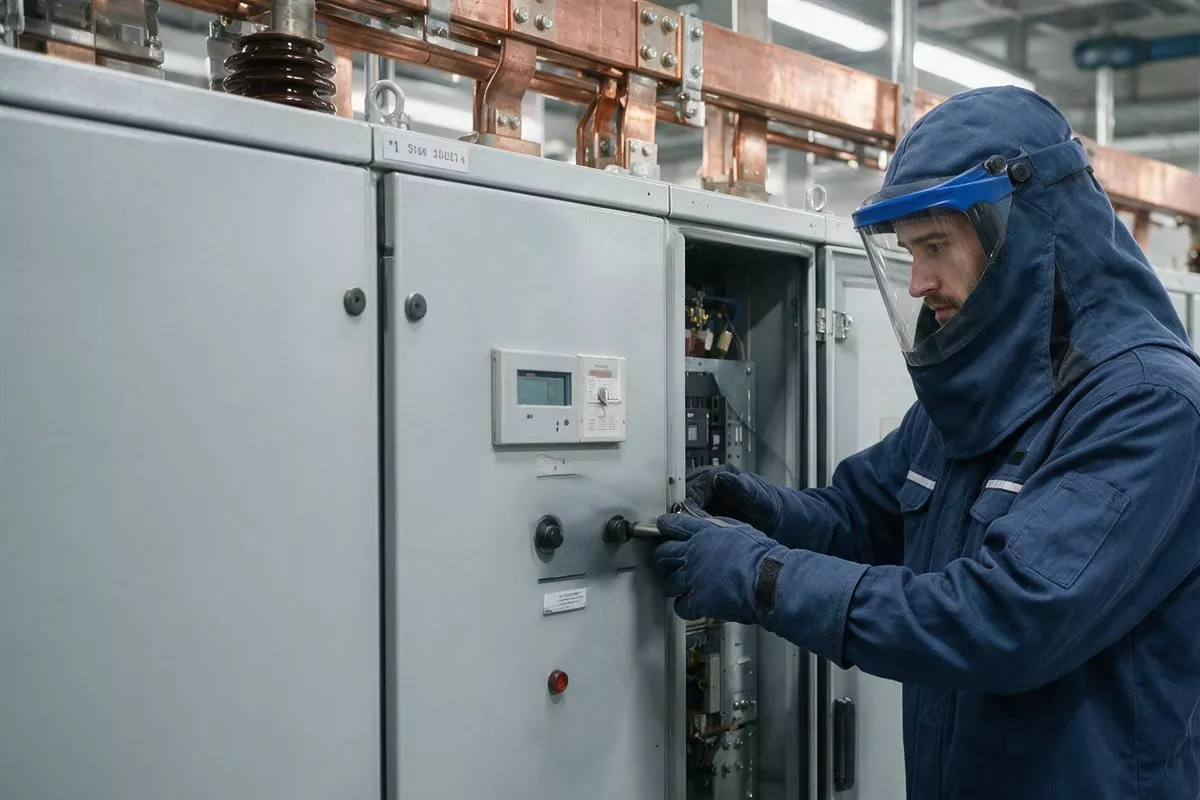
A capacitor bank is the one piece of electrical equipment that stays dangerous after the isolation has been proved. The breaker is open, the lock is on, the tester shows dead — and the bank is still holding a charge that can arc, burn and kill. Add the arc flash energy available at the terminals and you have a task where two different hazards have to be controlled in sequence.
Arc flash protection during capacitor bank maintenance is therefore not only a question of cal/cm². It is a question of stored energy, discharge time, verification and the discipline to wait. This guide covers the physics a maintenance team actually needs, the tasks that create the exposure, the PPE that matches them, and the checks that prevent the most common failure: treating a discharged bank as a dead one.
Capacitor work combines:
Arc flash from the available fault current at the terminals, which is often high because banks are installed close to the main busbar.
Stored energy in the capacitor itself, which remains after the supply is removed and can deliver a severe shock or a local arc when a terminal is touched or a fuse is replaced.
Re-energisation from adjacent banks, back-feed through harmonic filters, or automatic switching controls that are not locked out.
The PPE decision covers the first. The procedure covers the second and third. Neither alone is sufficient.
The energy in a capacitor is E = ½ C V². For a 100 kvar, 480 V bank, the capacitance is about 1,150 µF and the stored energy at full voltage is roughly 130 joules — comparable to the energy needed to lift 13 kg by a metre, released in milliseconds if the terminals are shorted. Larger medium-voltage banks store several kilojoules.
Three practical consequences:
Voltage matters more than capacitance. Energy rises with the square of voltage, so a bank that is only partly discharged can still hold a dangerous fraction of its energy.
Discharge is not instantaneous. Bleed resistors are sized to bring the bank below a safe voltage within a defined time — commonly one minute for banks rated 600 V or less and five minutes above that, following NEC Article 460. The resistor can fail, and the only way to know is to measure.
Measurement is part of the lockout. Proving the supply dead does not prove the bank discharged. Both have to be verified, at the terminals, with a meter rated for the voltage.
| Task | Why it is hazardous |
|---|---|
| Fuse replacement after a blown fuse | Frequently done live or immediately after isolation; the bank may not be discharged; fuses can rupture violently |
| Contactors and switching devices | High inrush current; repeated operation; worn contacts and loose connections |
| Thermographic survey | Enclosure open with the bank energised; face and torso close to terminals |
| Capacitor unit replacement | Heavy units, tight space, stored energy in the unit and in adjacent units |
| Harmonic filter maintenance | Detuned reactors and capacitors retain charge; back-feed from other sections |
| Busbar and cable termination work | Highest available fault current; tools inside the enclosure |
The fuse replacement task deserves special mention because it is the one most often performed in a hurry. A blown fuse is a symptom, not a fault: the bank may have failed internally, the discharge resistor may be open, and the replacement fuse may fail again on energisation. Diagnose before replacing, and never replace a capacitor fuse with the enclosure open and the bank connected.
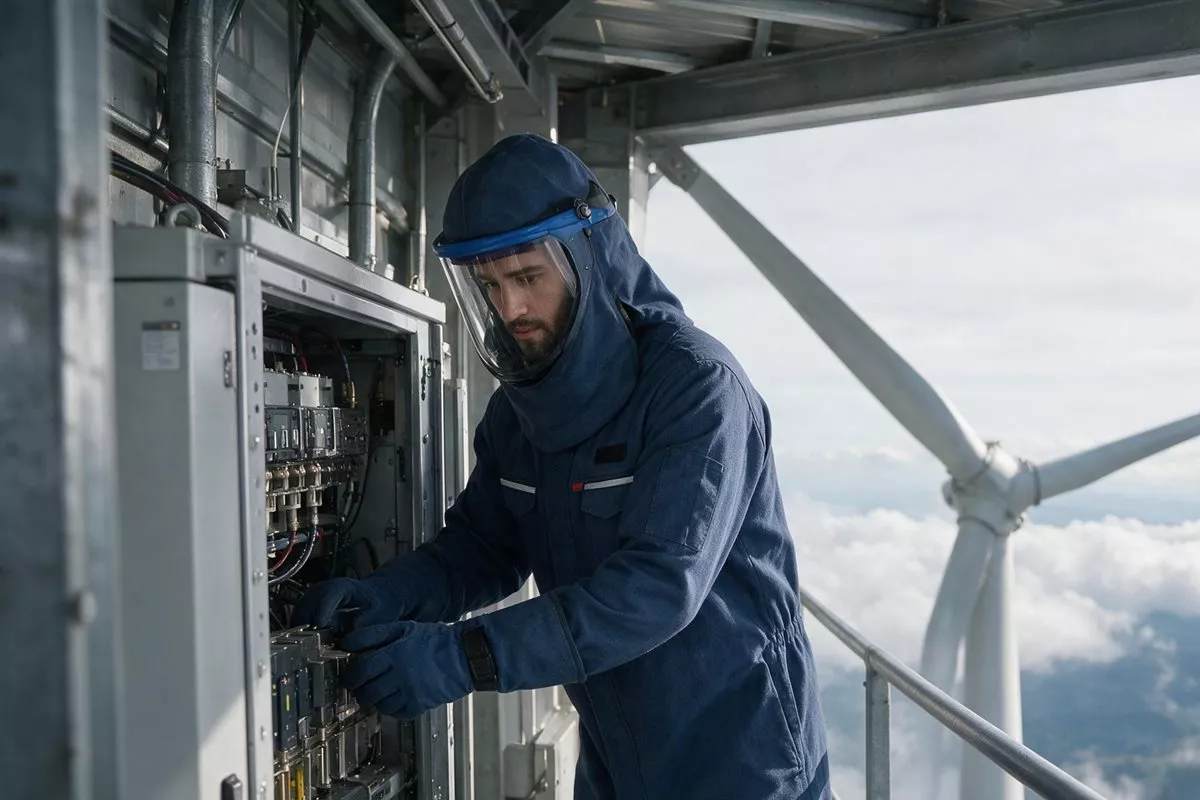
The arc rating comes from the incident energy study at the bank, adjusted for the task. The working distance inside a capacitor enclosure is short and the terminals are at the front, so the head and hands are the critical areas.
Arc-rated clothing to the calculated energy, not to the nominal rating of the installation. A 480 V bank on a high-fault bus can carry a higher category than the rest of the plant.
Hood or arc-rated face shield for any task with the enclosure open and the bank capable of being energised. Case rupture and fuse operation produce projectiles as well as heat.
Insulating gloves of the correct class with leather protectors, and arc-rated overgloves where the suit rating requires them. Our arc flash glove guide covers classes, sizing and the air test.
Insulated tools and no loose metal — no watch, ring, or tape measure on the busbars.
Hearing protection where switching produces high inrush or where case rupture is credible.
For medium-voltage banks, the utility-grade approach applies: switching from a remote or remote-operated position, arc-resistant switchgear where available, and a boundary that keeps everyone else out of the room. Our article on arc flash suit protection levels explains how the category maps to garment sets for these higher-energy tasks.
A workable sequence for a low-voltage bank:
Identify the correct bank from the drawing and the label, and identify every source, including back-feed from filters, adjacent banks and control circuits.
Isolate and lock the switching device, and lock the control supply so automatic switching cannot close the contactor.
Wait the discharge time stated by the manufacturer or the standard, and do not shorten it because the bank "usually" discharges faster.
Measure at the terminals with a meter rated for the voltage: phase to phase and each phase to earth. A reading that falls slowly indicates a failing bleed resistor; a reading that stays high means the bank is not safe to touch.
Discharge manually where the procedure requires it, using a properly rated discharge device, then measure again.
Ground where the procedure requires it, and keep the ground applied while work is in progress.
Re-measure before touch after any break in the work, because a bank can be re-energised by a control fault or a parallel source.
The measurement step is where procedures fail. A tester that is not rated for the voltage, or a probe that is not held on the terminal long enough for the reading to settle, gives a false "dead". Prove the tester on a known source before and after, as with any voltage verification.
Energising a bank is its own event. Inrush current can be many times the rated current, contactors wear, and a bank with a failed unit can fail on energisation. Controls that reduce the exposure:
Operate the switching device remotely or from outside the arc flash boundary wherever the design allows.
Stand to the side of the enclosure, not in front of the door, and keep the door closed during energisation.
Check the bank after energisation by instruments and thermography before opening anything.
Do not re-energise a bank that has operated a fuse or a pressure switch until the cause has been found.
Capacitors fail in ways that are not electrical. A ruptured case can release hot dielectric, and older units may contain dielectric fluids that are now restricted. For maintenance teams:
Treat a swollen, leaking or discoloured unit as failed and remove it from service.
Wear chemical-resistant gloves and eye protection for handling a leaking unit, in addition to the electrical PPE required by the task.
Dispose of the unit through the site's hazardous waste route; do not put it in general waste.
Ventilate the room after a rupture and keep ignition sources away until the area has been assessed.
Thermographic survey of terminals, fuses and busbar connections, with the enclosure closed where IR windows are fitted.
Check for bulging cases, discoloured paint, oil stains and corrosion at the mounting points.
Listen for abnormal hum or hissing, and check for vibration in the enclosure.
Record the capacitance or current per phase where the site monitors bank balance; a change indicates a failed unit.
Verify that ventilation openings are clear and that the room temperature is within the bank's rating.
A capacitor bank that is inspected by instruments between visits needs fewer open-enclosure interventions, and every avoided intervention is an avoided arc flash exposure.
No. The bank stores energy and remains dangerous until it has discharged and the terminals have been measured dead. Bleed resistors can fail, and the only reliable check is a measurement at the terminals with a suitably rated meter.
Follow the manufacturer's stated discharge time and the applicable standard — commonly one minute for banks rated 600 V or less and five minutes above 600 V, per NEC Article 460. Waiting is not a substitute for measuring.
No. Isolate, lock out the control supply, wait, measure and discharge before replacing a fuse. A fuse failure is usually a symptom of a failed unit or a discharge problem, and the replacement should not be energised until the cause is understood.
Arc-rated clothing, face protection and gloves to the incident energy at the open enclosure. The camera does not reduce the hazard. Where IR windows are fitted and used with the enclosure closed, the exposure is substantially lower.
Yes. Lock the switching device and the control supply so automatic switching cannot re-energise the bank, identify every back-feed source, and treat the stored charge as a separate energy source that must be discharged and verified.
If you maintain capacitor banks or harmonic filters, send the bank ratings and switching arrangement to the C&G team. We can match arc-rated clothing, hoods and insulating gloves to the incident energy at the bank, and supply the documentation your isolation procedure needs. The full arc flash protective clothing range covers suits from 7.5 to 67 cal/cm² for low- and medium-voltage work.

Shanghai C&G's personal protective clothing and PPE products are trusted by customers in the world. Our products are exported worldwide, with a strong presence in the United States, China, Japan, Germany, the United Kingdom, India, France, Italy, Brazil, and Canada. In addition, we have a significant customer base in other countries across each continent, including Australia, New Zealand, South Africa, Nigeria, and Egypt in Africa; Argentina, Chile, and Mexico in South America; Russia, South Korea, and Indonesia in Asia; Spain, Poland, and Turkey in Europe; and Saudi Arabia and the United Arab Emirates in the Middle East. Wherever you are in the world, we have the products you need to stay safe and protected. Contact us today to learn more about our products and how we can help you meet your safety needs.










Shanghai C&G is committed to building a leading brand in the safety emergency industry with technological innovation as the core and sustainable development, providing customers with one-stop safety emergency solutions, escorting the safety of customers, and make the world safer!
Building 39, Lane 123, Shenmei Road, Pudong New District, Shanghai, China
inquiry@cgprotection.com
+86-21-38214394


© 2023 Shanghai C&G. All Rights Reserved.