Shanghai, China
+86-17317656853
inquiry@cgprotection.com

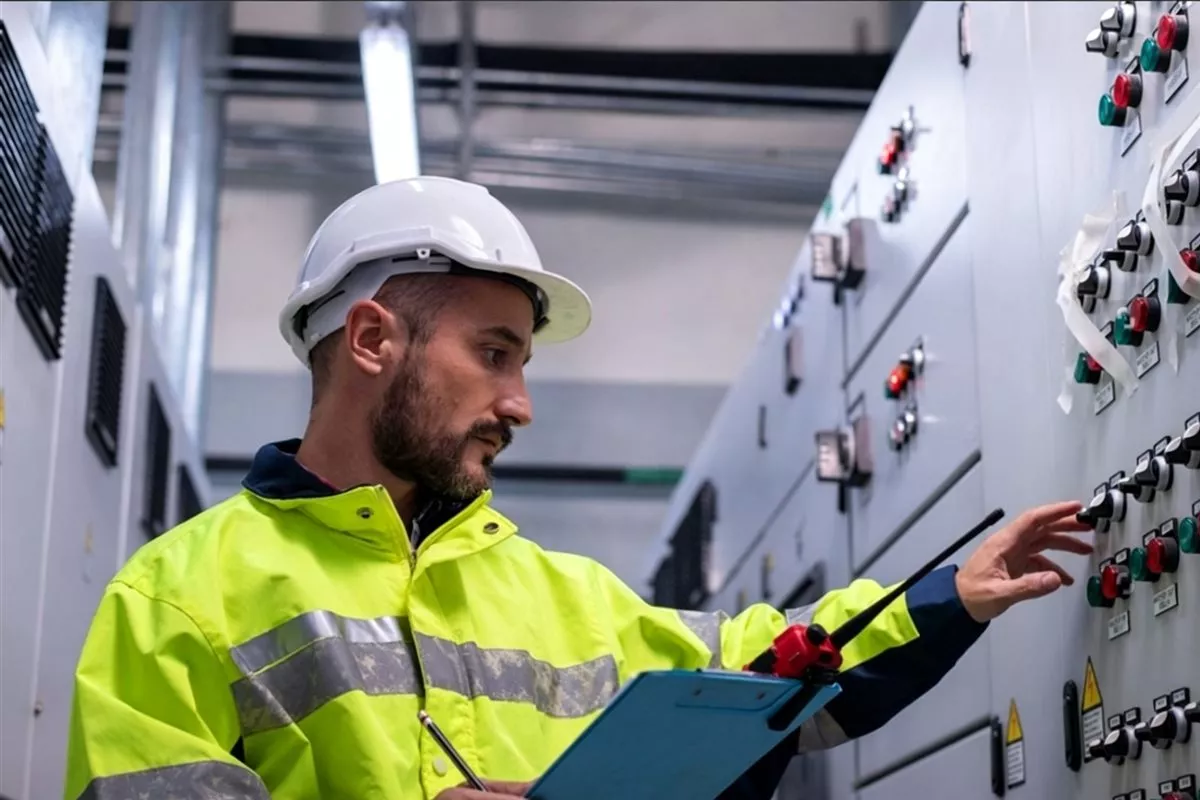
Data centres are designed around one promise: the load never goes off. That promise shapes every electrical task inside them. The switchgear cannot be shut down for a routine inspection, the UPS cannot be bypassed for a bolt check, and the battery string stays energised because the batteries are what keeps the room alive. The result is a facility with high available fault current, dense equipment and a maintenance culture built around live work — exactly the conditions where an arc flash suit stops being a formality.
Arc flash protection in data centres and UPS rooms has its own logic. The incident energy is concentrated at the UPS input and output, the PDUs and the battery cabinets; the arcs can be DC as well as AC; the working space is often too tight for a full suit; and heat stress is a real constraint because the room is already warm. This guide covers where the energy sits, why battery strings behave differently, and how to specify suits and procedures that fit a facility that cannot afford an outage.
A data centre's electrical chain concentrates fault current at a few points, and those points are where the suits are needed:
| Location | Why it matters |
|---|---|
| Utility service entrance and main switchboard | Highest available fault current in the facility; the utility transformer sets the ceiling |
| UPS input and output breakers | Large battery-backed source; output breakers can be fed from the UPS with the utility disconnected |
| Static transfer switches and PDU input | Dual-source equipment; both sources may be live when the panel is opened |
| Battery cabinets and strings | DC arc with no zero crossing; stored energy independent of the AC supply |
| Generator and ATS gear | Fault current from the generator plus the utility; transfer sequences create live transitions |
| Remote power panels and busway taps | Often installed in tight white-space locations, worked on from a ladder |
The common mistake is to assign one PPE level to "the data hall". Incident energy varies by an order of magnitude between the main switchboard and a remote panel fed by a long cable run, and the study has to be done per location, with the results printed on the equipment.
DC arcs do not pass through zero twice per cycle, so they do not self-extinguish the way AC arcs often do. A battery string at 400–600 V DC can sustain an arc across a gap that AC would clear, and the available short-circuit current from a large VRLA or lithium string is limited mainly by the string's internal resistance and the length of the cabling.
Practical consequences for the work:
The AC isolation does not make the string safe. The batteries are the source; only opening the string — and often only removing links — removes the energy.
Tools must be insulated and controlled. A dropped wrench across a string is a bolted fault with no protective device fast enough to help.
PPE is selected for DC. Arc-rated clothing, face protection and insulating gloves rated for the DC voltage; a suit rated for the AC incident energy may not cover a DC arc of similar current.
Hydrogen and thermal runaway add a second hazard in vented lead-acid and some lithium installations. Ventilation, gas detection and a fire response plan sit alongside the electrical PPE.
Our article on arc flash protection for solar, battery storage and wind sites covers the DC side in more depth, including how string-level work changes the boundary.
Uptime discipline produces a particular failure mode: tasks are broken into small live interventions, each individually "quick", and the cumulative exposure grows. A workable programme accepts the constraint and controls it:
Method of procedure first. Every task has a written MOP with the isolation points, the verification steps, the PPE level and the rollback. No MOP, no work.
Remote operation wherever it exists. Breakers with remote operators, maintenance switches outside the arc boundary and IR windows on closed panels remove exposure entirely. Specify them at design stage; retrofit them during the next planned outage.
Group the live work. Where a panel must be opened, do all the tasks that need it open in one session behind one barrier, rather than three separate visits.
Two-person rule for the highest-energy points. One to work, one to operate the isolation and call for help. In a facility with no other electrical staff on shift, that means scheduling.
Thermography through windows. Most loose-connection faults are found with the panel closed. The camera does not need the door open; the technician does not need the suit.
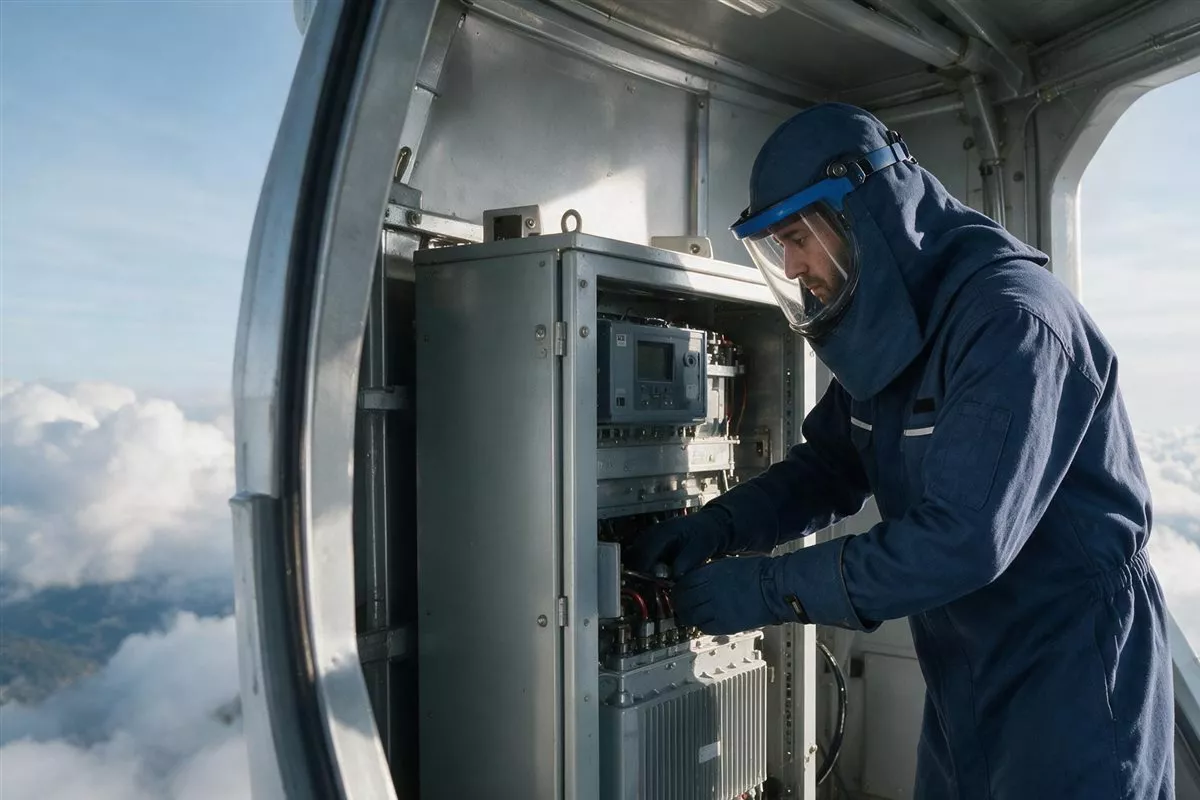
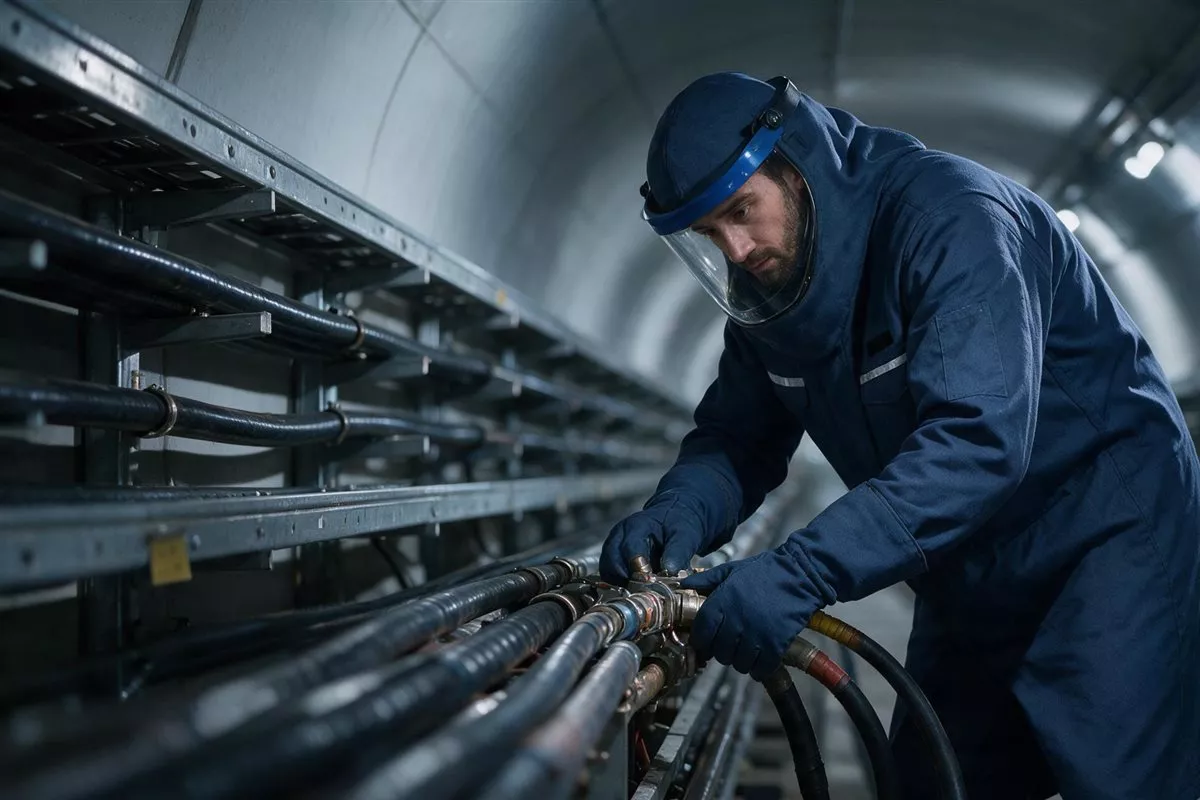
Data halls are tight, warm and full of obstructions. That changes the specification compared with an outdoor substation:
Match the category to the location. Category 1 daily wear at a remote panel is not the same requirement as a category 4 set at the main switchboard. Our guide to arc flash suit protection levels maps categories to garment sets and working distances.
Prefer a jacket-and-trouser set for confined work. A full coverall in a narrow aisle restricts kneeling and twisting; a two-piece set with a short jacket is easier to move in and easier to doff if heat stress builds.
Hood or face shield, not neither. Working at arm's length in a cabinet puts the face in the arc path. A hood with a hard cap and a face shield with balaclava are the two options; the choice follows the incident energy and the dexterity needed.
Plan for heat. Suits are worn in rooms at 24 °C with hot aisles nearby, under UPS rooms that are warmer still. Hydration, work-rest cycles and a cool-down area are part of the PPE programme, not welfare extras.
Keep the gloves and tools matched. Insulating gloves to the voltage, leather protectors, and insulated tools for the terminals — the suit rating does not protect a hand that bridges two phases. See the insulating glove guide for classes and retest intervals.
Much of the live work in a data centre is measurement: verifying a transfer, checking a UPS output, commissioning a PDU. The meter and its leads are part of the PPE decision. A CAT III meter with CAT II leads is a CAT II system; at a UPS output or a service entrance, CAT IV is normally required. Our article on arc flash PPE for electrical testing covers the instrument side in detail.
Label every panel with the incident energy, the boundary and the PPE category from the study, including battery cabinets.
Keep the study current. A UPS replacement or a new PDU changes the fault current. Re-run the study when the topology changes, not on a fixed calendar.
Record live work. Date, location, task, PPE level, the person who verified the isolation and the person who authorised the work.
Train for the room. Generic arc flash training does not teach a technician where the dual feeds are in a particular hall. Walk the site, name the sources, practise the isolation.
Anyone opening energised equipment or working within the arc flash boundary needs arc-rated PPE to the incident energy at that point. Reading a screen through a closed door does not; opening a PDU or a UPS output breaker panel does.
Not necessarily higher, but different: the UPS is a second source that can feed a fault with the utility disconnected, and the battery string adds DC energy. The study has to treat each location on its own.
Only if the garment assessment covers the DC exposure at that location. DC arcs behave differently and the incident energy calculation is separate. Where the string voltage and current are significant, specify PPE for the DC case.
Remote operation, IR windows, closed-panel thermography, grouping live tasks into one session and using maintenance-free connections at design stage. Each of these removes a door-opening event, which is where the exposure lives.
Plan work-rest cycles, hydration, a cool-down area and the shortest possible task duration. A two-piece suit is easier to doff than a coverall, and a hood with a wide window improves visibility without adding heat.
If you are specifying arc-rated PPE for a data centre, a colocation hall or a UPS room, send the single-line diagram and the study results to the C&G team. We can match suit sets, hoods, gloves and instrument ratings to each location in the chain. The full arc flash protective clothing range covers suits from 7.5 to 67 cal/cm² and the accessories that go with them.
Tags: data centre, ups rooms, arc flash suit

Shanghai C&G's personal protective clothing and PPE products are trusted by customers in the world. Our products are exported worldwide, with a strong presence in the United States, China, Japan, Germany, the United Kingdom, India, France, Italy, Brazil, and Canada. In addition, we have a significant customer base in other countries across each continent, including Australia, New Zealand, South Africa, Nigeria, and Egypt in Africa; Argentina, Chile, and Mexico in South America; Russia, South Korea, and Indonesia in Asia; Spain, Poland, and Turkey in Europe; and Saudi Arabia and the United Arab Emirates in the Middle East. Wherever you are in the world, we have the products you need to stay safe and protected. Contact us today to learn more about our products and how we can help you meet your safety needs.










Shanghai C&G is committed to building a leading brand in the safety emergency industry with technological innovation as the core and sustainable development, providing customers with one-stop safety emergency solutions, escorting the safety of customers, and make the world safer!
Building 39, Lane 123, Shenmei Road, Pudong New District, Shanghai, China
inquiry@cgprotection.com
+86-21-38214394


© 2023 Shanghai C&G. All Rights Reserved.